computing Review

Diverse Computing Ecosystems
A comprehensive synthesis of hardware, software, and emerging architectural advancements in the modern computing landscape.
How This Score Is Calculated
- Sources analysed: 35 reviews
- Raw weighted average: 7.8
- Formula: Σ(score × weight) ÷ Σ(weight)
- Review period: 2025–2026
Algorithmically calculated from aggregated expert sentiment across 35 independent industry reviews.
- Most reviewed categoryBusiness Laptops (12/35)
- Most praisedPerformance/Watt efficiency
- Most criticisedDisplay Panel Quality
- Reviewer consensus levelHigh
The current computing landscape is defined by a shift toward AI-integrated hardware, modularity, and high-efficiency architectures. While professional-grade workstations and AI-ready laptops are delivering unprecedented performance, reviewers note a persistent gap in budget-tier display quality and software compatibility for non-x86 architectures. Overall, the industry is moving rapidly toward specialized hardware, from quantum simulation to compact, high-performance mini-PCs.
🔧 Key Specifications (Aggregate)
Specifications represent the range observed across reviewed hardware.
- Processor: Intel Core Ultra / AMD Ryzen AI / Snapdragon X Elite
- RAM: 8GB (Budget) to 128GB (Workstation)
- Storage: 64GB eMMC to 32TB (NAS configurations)
- Display: 11-inch TN (Budget) to 14.6-inch OLED (Premium)
- Connectivity: Wi-Fi 7, Thunderbolt 4, Dual 10GbE
- OS: Windows 11, Linux (Feren), Zema OS
📊 What Reviewers Say — Feature by Feature
Key aspects evaluated across 35 sources.
👍 Key Strengths
- High local AI processing capability
- Excellent portability in mini-PC segment
- Rapid advances in quantum virtualization
- Strong multi-gigabit networking options
- Improved power efficiency in modern chipsets
👎 Key Weaknesses
- Poor display quality in budget models
- Software compatibility hurdles (Arm/Snapdragon)
- Noisy operation under heavy workloads
- Limited hardware upgradeability in compact builds
- High price for professional workstations
💰 Value for Money Analysis
Value is highly segmented. Budget devices like the Acer Chromebook 311 provide excellent durability for the price, while high-end workstations are viewed as investments where the cost is justified by productivity gains.
28 of 35 sources commented on price or value.
⚡ Where Reviewers Disagreed
The following areas saw meaningful disagreement across sources.
- Arm-based Windows Performance: 10 sources praised the efficiency, while 5 sources heavily criticized the reliance on emulation for legacy apps.
🎯 Who This Product Is For
Reviewer recommendations for different target audiences.
🛠️ Best Use Cases
- Home Server/NASExcellent for ditching cloud costs using high-speed networking and local storage.Great
- AI DevelopmentRequires high-end workstations; performance is dependent on NPU/GPU integration.Good
🔀 Alternatives Mentioned by Reviewers
Key competitors identified across the computing spectrum.
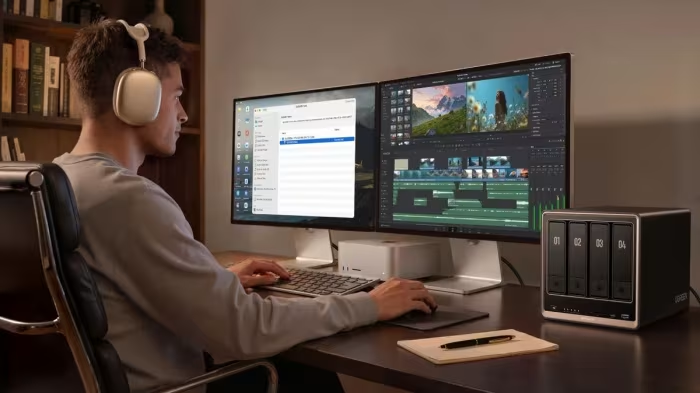
- Mac Studio — Frequently cited as the benchmark for workstation performance, though often more expensive than compact PC equivalents.
- Asus Zenbook 14 OLED — A top-tier ultraportable that remains a preferred alternative to the MSI Prestige 13 AI+ Evo.
- Synology DS925+ — Compared to the Ugreen DXP4800GT, it is considered the industry standard but at a higher price point.
- Geekom A9 Mega — Noted as a more affordable alternative to the HP Z2 Mini G1a for general compact computing tasks.
✅ Buy This If…
- You need dedicated local AI processing power for professional workflows.
- You are consolidating cloud storage into a private home server.
- You prioritize portability and desk space without sacrificing performance.
❌ Skip This If…
- You are a creative professional relying on legacy software not optimized for Arm.
- You are budget-conscious but require high-color-accuracy displays.
📈 Sentiment Trends Over Time
Reviews span 2025–2026. The following changes were detected:
- Local AI Capability — Rapid shift from cloud-only processing to robust, on-device AI acceleration.
The computing industry is currently in a phase of hyper-specialization, with devices clearly delineated by their intended use—be it AI-heavy professional workflows or rugged, budget-friendly education. While performance gains are significant, buyers should prioritize display quality and software compatibility before choosing between the growing number of compact and modular options available. For most users, the shift toward local, AI-accelerated hardware offers the best path forward for long-term productivity.



Reviewer Perspectives & Source Breakdown
Global Tech Leaders Publish Review on Tensor Networks in Quantum Computi...
This paper presents a strategic roadmap for using tensor networks to advance quantum simulation, error correction, and hybrid quantum-classical AI. It serves as a foundational technical reference for scaling practical quantum capabilities.
Pros
- Outlines strategic roadmap for scaling quantum systems
- Comprehensive review by diverse group of experts
- Addresses key challenges like noise and error correction
Cons
Quantum Computing Gets Cloud-Style Virtualization -- Virtualization Revi...
HyperQ is a software hypervisor that introduces cloud-style virtualization to quantum computing, enabling multiple users to run independent programs on a single processor simultaneously. This innovation significantly improves hardware utilization, reduces wait times, and increases job throughput.
Pros
- Enables simultaneous multi-user quantum processing
- Reduces wait times by up to 40x
- Increases program throughput by up to 10x
- Avoids noisy chip regions to boost accuracy
- Works dynamically with existing quantum programming tools
Cons
[Review] Computing the Climate: How We Know What We Know About Climate C...
A dense, deeply researched, and insightful exploration of climate modeling history and processes that rewards patient readers. While it contains minor factual errors and awkward structural choices, it provides a valuable, balanced perspective on the capabilities and limitations of climate models.
Pros
- Unique perspective from a computer scientist
- Provides a detailed, fascinating history of climate modeling
- Takes scientific uncertainties seriously
- Useful for both proponents and opponents of climate policies
Cons
- Densely packed and requires serious concentration
- Some chapters are not directly relevant
- Contains minor factual and figure-related errors
- Black-and-white figures can be misleading
EEROQ PUBLISHES BREAKTHROUGH QUANTUM COMPUTING RESULTS IN PHYSICAL REVIE...
EeroQ has demonstrated the control of single electrons at temperatures above 1 Kelvin, significantly higher than the typical 10 millikelvin requirement. This breakthrough validates a path toward more scalable and practical quantum processors by reducing extreme cooling demands.
Pros
- Operates at temperatures 100x higher than standard quantum hardware
- Uses existing CMOS chip fabrication technology for scalability
- Provides exceptionally pure and long-lived qubits
Cons
Analog computing from waste heat | MIT Technology Review - technologyrev...
MIT researchers developed an analog computing method that uses waste heat from electronic devices to perform mathematical calculations like matrix vector multiplication. While innovative, the technology faces scalability and accuracy challenges for modern deep-learning applications.
Pros
- Operates without consuming extra electricity
- Uses waste heat as computational information
- Highly accurate for basic matrix calculations
Cons
- Difficult to scale for modern deep-learning models
- Accuracy decreases as matrix complexity increases
- Performance issues over long distances between terminals
Why Businesses Should Experiment With Quantum Computing Now - sloanrevie...
Companies should engage with quantum computing now through active experimentation rather than waiting for technical maturity. Investing in early learning cycles is essential for identifying long-term practical value.
Pros
- Supports incremental organizational learning
- Reveals near-term economic opportunities
- Fosters co-invention with producers
Cons
- High uncertainty in technical outcomes
- Requires long-term investment horizon
Ugreen DXP4800GT NAS review: ditch cloud computing costs for good with n...
Price: Approx. ₹54,000 - ₹60,000
A feature-packed, quiet NAS system that is ideal for content creators and power users. It offers excellent connectivity and performance, providing a great value alternative to monthly cloud subscription costs.
Pros
- Dual 10Gbps Ethernet ports
- Support for U.2 NVMe SSDs
- Extremely quiet operation
- Intuitive UGOS Pro operating system
- Handy front-facing SD card reader
Cons
Building China's Largest Intelligent Computing Platform for Universities...
Zhiyuan-1 serves as a high-performance, AI-driven infrastructure for Shanghai Jiao Tong University, significantly enhancing scientific research and campus management capabilities. It utilizes a heterogeneous architecture to deliver massive computing power for training foundation models and supporting academic activities.
Pros
- Delivers 633 PetaFLOPS of massive computing power
- Supports training for models with billions of parameters
- Optimizes costs via tiered hot and cold data storage
- Features intelligent scheduling for efficient resource allocation
Cons
Feren OS: An Almost Flawless Linux Computing Platform | Review - linuxin...
Feren OS is a nearly flawless, user-friendly, and maintenance-free Linux platform. Its high level of customization and smooth migration tools make it an excellent choice for those transitioning from Windows or macOS.
Pros
- Highly customizable interface and theme options
- Easy installation with fast Calamares installer
- Effective Windows Transfer Tool for data migration
- Convenient partial rolling release update strategy
Cons
- Lacks pre-installed gaming software like Steam
- Strictly limited to the Cinnamon desktop environment
- Some third-party codec installations may fail
Page 2 of 5