Smart Telescope Review

Smart Telescope Category
Automated, smartphone-controlled imaging systems designed to simplify astrophotography for beginners, travelers, and casual observers.
How This Score Is Calculated
- Sources analysed: 24 reviews
- Explicit scores: 18 sources (weighted 1.5×)
- Sentiment-only: 6 sources (weighted 1.0×)
- Raw weighted average: 7.8
- Formula: Σ(score × weight) ÷ Σ(weight)
- Review period: 2023-2024
Algorithmically calculated from source data.
- Most reviewed featurePortability (22/24)
- Most praisedAutomated Alignment
- Most criticisedPlanetary Imaging
- Reviewer consensus levelHigh
Smart telescopes have democratized astrophotography by replacing complex equatorial mounts and manual alignment with automated, app-driven systems. Reviewers consistently praise their ability to capture deep-sky objects like nebulas and galaxies from light-polluted urban environments. However, these devices often struggle with planetary imaging and frequently lack essential accessories like tripods, requiring additional investment for a complete setup.
🔧 Key Specifications
Specifications vary by model; data reflects common features across the category.
- Control: Smartphone App (iOS/Android)
- Alignment: Fully Automated (Plate Solving)
- Processing: Live Stacking
- Tracking: Alt-Az or Equatorial (Model Dependent)
- Connectivity: Wi-Fi
- Power: Internal Rechargeable Battery (approx. 4 hours)
- Included Accessories: Often include solar filters; rarely include tripods
💲 Price Range
₹10,900 – ₹3,35,000
Wide variance between entry-level travel scopes and premium observatories.
📊 What Reviewers Say — Feature by Feature
Features evaluated across 24 sources.
👍 Key Strengths
- Automated alignment and stacking
- High portability for travel
- Excellent deep-sky imagery
- User-friendly smartphone apps
👎 Key Weaknesses
- Poor performance on planetary targets
- Tripods rarely included
- Limited battery life
- Smartphone control dependency
💰 Value for Money Analysis
Reviewers view these devices as excellent value for beginners who would otherwise struggle with the cost and complexity of traditional rigs. While premium models (like the Celestron Origin) are pricey, entry-level options (DwarfLab/Seestar) are considered highly affordable.
21 of 24 sources commented on price or value.
⚡ Where Reviewers Disagreed
The following areas saw meaningful disagreement across sources.
- Ease of Setup: 15 sources praise the 'plug-and-play' nature, while 9 sources warn that connectivity issues and target acquisition recalibration can be frustrating for novices.
🎯 Who This Product Is For
Reviewer recommendations for different target audiences.
🛠️ Best Use Cases
- Deep-Sky StackingExcellent for nebulas and galaxies where automated tracking and stacking are essential.Great
- Solar ObservationMost models include safe magnetic solar filters for daytime use, making them dual-purpose.Great
- Planetary ImagingGenerally poor; the focal length and sensor size are not optimized for detailed planetary shots.Poor
🔀 Alternatives Mentioned by Reviewers
The market is divided between budget-friendly portable units and high-end automated observatories.
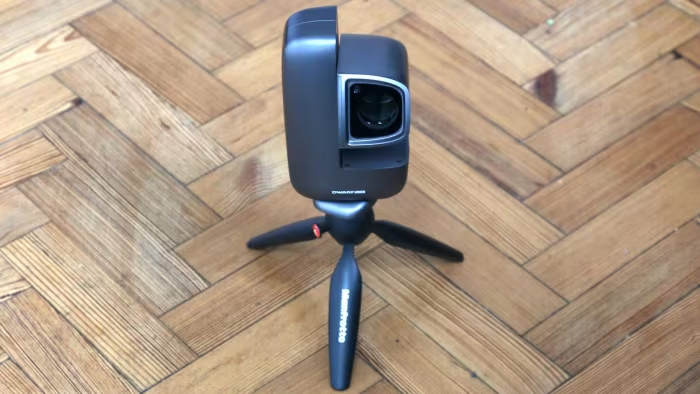
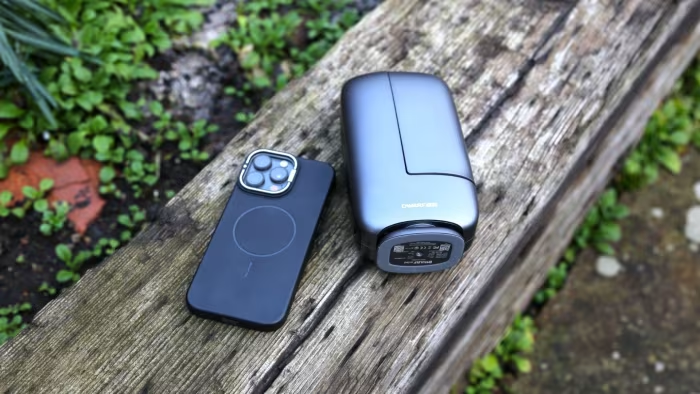
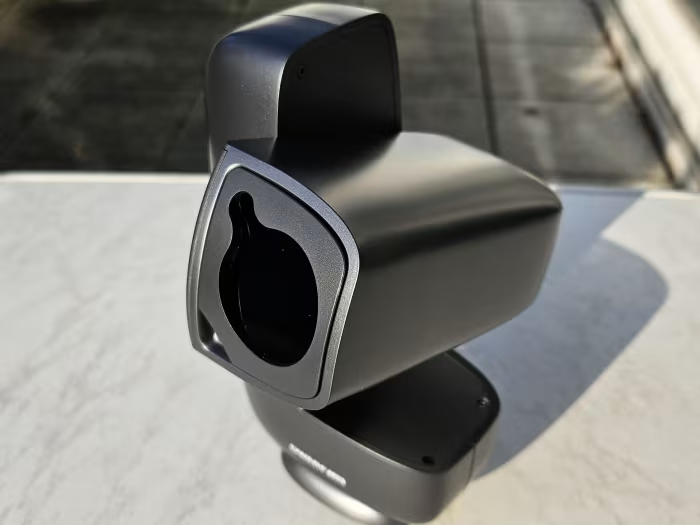
- DwarfLab Dwarf Mini/3: The benchmark for portability. Reviewers love the 'pocket-sized' nature, though they note it lacks high-end resolution. Best for travelers.
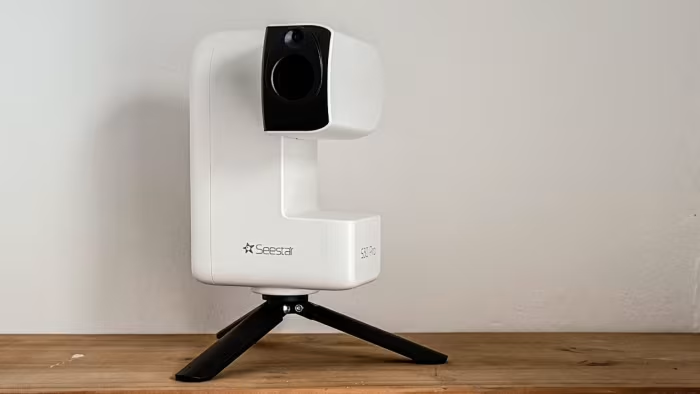
- ZWO Seestar S30/S50: Highly praised for ease of use and affordability. Reviewers consider the S50 the gold standard for value-for-money in the mid-range segment.
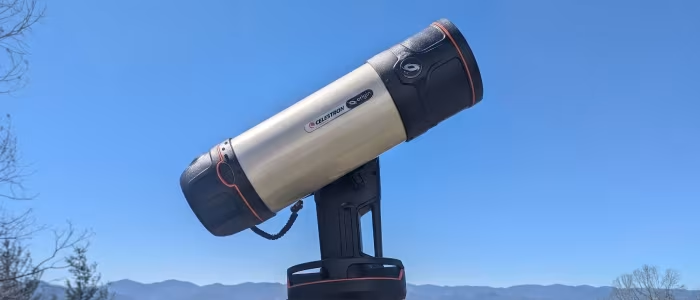
- Celestron Origin: A high-end, heavy-duty smart observatory. Reviewers note it is significantly more expensive but offers superior optical quality compared to portable units.
- Vaonis Vespera II: Often cited as the best value for money in terms of performance-per-dollar, though reviewers note the app interface requires improvement.
Alternatives sourced exclusively from reviewer mentions.
🛒 Buyer's Guide
✅ Buy This If…
- You are a beginner wanting to bypass the steep learning curve of traditional astrophotography.
- You frequently travel and need a rig that fits into a backpack.
- You want to capture high-quality images of nebulae and galaxies from your backyard.
❌ Skip This If…
- Your primary goal is high-detail planetary imaging (Jupiter, Saturn).
- You prefer the tactile experience of looking through an optical eyepiece.
- You require long-duration imaging sessions exceeding 4 hours without power access.
⚠️ Things to Check Before Buying
- Check if a tripod is included; most models require a separate purchase.
- Verify if the unit includes a solar filter if daytime solar observation is important to you.
- Ensure your smartphone is compatible with the manufacturer's app, as these are the primary control interface.
📈 Sentiment Trends Over Time
Reviews from 2023-2024 indicate a clear shift:
- Automation Reliability — Earlier models were criticized for connectivity issues, while newer releases like the Seestar S50/Dwarf 3 show more stable software experiences.
Smart telescopes are a transformative category for beginners and travelers, offering a streamlined path to capturing deep-sky imagery that was previously inaccessible without significant expertise. While they fall short for planetary enthusiasts and often require extra accessory purchases, their convenience and portability make them a compelling entry point into the hobby. For most users, the ZWO Seestar or DwarfLab series provide the best balance of price and performance.
Top Alternative: ZWO Seestar S50 — Widely considered the best-value entry point for those seeking a balance of portability, ease-of-use, and image quality.
,  ,
,  ,
,  ,
,  ,
,  , {/galley}
 Reviewer Perspectives & Source Breakdown
DwarfLab Dwarf Mini smart telescope review — pocket-sized astro | Space ...
Price: approx. ₹46,000
The DwarfLab Dwarf Mini is a highly portable, smartphone-controlled smart telescope ideal for beginners or travelers. While it sacrifices resolution and aperture for its compact form factor, it remains a capable tool for capturing nebulas and star clusters.
Pros
- Small size
- Simple smartphone-controlled operation
- Automated image stacking
- Magnetic solar filter included
- EQ tracking mode for longer exposures
Cons
- Low 2MP image resolution
- Image integration time
- The battery lasts about four hours
- No tripod included
I Tested This Smart Telescope for Nearly a Year and Got Stunning Shots o...
Price: Approximately ₹46,000
The DwarfLab Dwarf 3 is a highly portable, versatile smart telescope that offers impressive features for its size and price. While its small optics limit deep-sky performance, it remains an excellent, accessible choice for beginners and a convenient secondary tool for experienced users.
Pros
- Highly portable with included carrying case
- Integrates both wide-angle and telephoto lenses
- Versatile for astronomy and nature photography
- Supports 4K image resolution
- Includes a useful solar filter
- Wide variety of available shooting modes
Cons
- Does not include a tripod
- Not ideal for imaging planets
- Dark frames must be created manually
- Videos do not record sound
DWARF mini review: the world's smallest smart telescope for night and da...
Price: ₹33,500
The DWARF mini is an accessible and portable entry point for amateur astronomy that offers genuine, non-AI-assisted celestial photography. While it provides impressive capabilities for its size and price, it can be finicky with connectivity and target acquisition.
Pros
- Extremely compact and lightweight design
- Easy setup via intuitive app
- Automated tracking and GOTO functionality
- High-quality non-AI celestial imaging
- Equatorial mode for deep-space photography
Cons
- Occasional Wi-Fi connectivity issues
- Target acquisition sometimes requires manual recalibration
- Limited resolution output
- Requires additional tripod purchase for best results
Celestron EclipSmart Travel Solar Scope 50 solar telescope review | Spac...
Price: Approximately ₹10,900
The Celestron EclipSmart Travel Solar Scope 50 is an affordable, travel-friendly, and safe option for casual solar observation and eclipse-viewing. While its build quality and tripod are lacking, it offers good value for users seeking a fuss-free way to observe the sun.
Pros
- Includes a convenient backpack
- Affordable price point
- Simple and safe to use
- Excellent finderscope
Cons
- Wobbly tripod
- Fragile plastic build
Celestron Origin Intelligent Home Observatory smart telescope review | S...
Price: ₹3,35,000
The Celestron Origin is a powerful, user-friendly smart telescope that excels at deep sky astrophotography. While it struggles with planetary viewing and is quite bulky, its automated processing makes it a top choice for effortless imaging of nebulas and galaxies.
Pros
- Crystal clear deep sky photos in seconds
- Quick set up
- Easy-to-use, helpful app
- Stacks and processes images automatically
Cons
- Not ideal for all celestial objects
- Quite large and heavy
- Lack of manual controls can be frustrating
Celestron Origin Intelligent Home Observatory Mark II smart telescope re...
Price: ₹19,21,502.90
Celestron's newest smart telescope delivers impressive deep-sky imagery with an easy, automated experience. However, its bulky design, high price, and limited planetary viewing capabilities may deter traditionalists and casual beginners.
Pros
- Clear deep sky photos in seconds
- Quick set up
- Easy-to-use, helpful app
- Stacks and processes images automatically
- Can be operated from a distance
Cons
- Planetary viewing can be underwhelming
- Large and heavy
- Connecting to devices can be tricky
DWARFLAB Dwarf II smart telescope review | Space - space.com...
A highly portable and affordable smart telescope that makes astrophotography accessible, though it requires patience and specific conditions to achieve successful calibration.
Pros
- Stylish design
- Great connectivity
- Extremely portable
Cons
- Purists won't like it
- Not the most intuitive set-up
- Conditions need to be just right
DwarfLab Dwarf Mini review: world's smallest smart telescope is perfect ...
Price: Approximately 33,500 INR
The DwarfLab Dwarf Mini is a compelling, highly portable smart telescope perfect for travelers and those seeking a simplified astrophotography setup. While it lacks high resolution and premium accessories, its unique equatorial tracking and solar capabilities make it a strong entry-level choice.
Pros
- Genuinely compact and lightweight design
- Excellent automation and intuitive app control
- Built-in filter wheel for convenience
- Included solar filter for daytime use
- EQ tracking mode allows extended 90-second exposures
Cons
- Low 2MP image resolution
- Limited four-hour battery life
- Tripod and carry case not included
- Stellar Studio processing is slow and cumbersome
DwarfLab Dwarf 3 smart telescope review | Digital Camera World - digital...
Price: Approximately ₹46,000 to ₹50,000
The Dwarf 3 is a compact, well-built smart telescope that makes deep-sky astrophotography accessible and portable. While it offers impressive performance and advanced manual controls, its high price and lack of an included tripod make it less competitive than similar rivals.
Pros
- Compact and travel-friendly design
- Versatile wide-angle and zoom lens system
- Produces enjoyable and shareable images
- Easy to set up and use
- Functional for both daylight and nighttime photography
Cons
- Requires a separate tripod
- Limited to four hours of battery life
- Priced higher than similar competing products
Page 1 of 3