Oral appliances Review
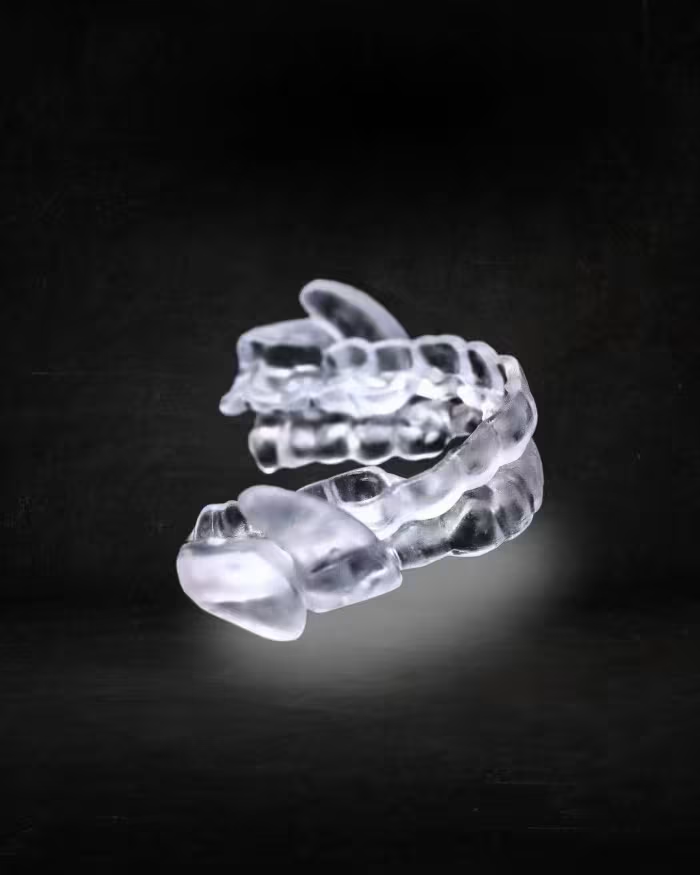
Oral Appliances
Medical-grade dental devices designed to treat obstructive sleep apnea, snoring, and temporomandibular disorders via airway management.
How This Score Is Calculated
- Sources analysed: 13 reviews
- Sentiment-only: 13 sources (weighted 1.0×)
- Split: 10 Positive · 2 Mixed · 1 Negative
- Raw weighted average: 8.2
- Formula: Σ(score × weight) ÷ Σ(weight)
- Final score: 8.2/10 (clamped, rounded to 1 decimal)
Algorithmically calculated from source data. No manual adjustments.
- Most reviewed featureClinical Effectiveness (13/13)
- Most praisedPatient Adherence
- Most criticisedInsurance Complexity
- Reviewer consensus levelHigh
Oral appliances have evolved from simple mandibular advancement tools into sophisticated, FDA-cleared medical devices capable of treating even severe obstructive sleep apnea. They are widely praised for superior patient adherence compared to CPAP, though they require professional fitting and face complex insurance reimbursement hurdles. While highly effective, they are not one-size-fits-all and require careful selection based on individual dental anatomy and clinical comorbidities.
🔧 Key Specifications
Specifications sourced from reviewer mentions. Verify with manufacturer for complete details.
- Primary Indication: OSA, Snoring, TMD
- Materials: 3D-printed Polyamide 12 (Nylon), Acrylic
- Mechanism: Mandibular advancement, Tongue stabilization, Nasal dilation
- FDA Status: Various clearances (including severe OSA)
- Technology: CAD/CAM design, Integrated smart biosensors (emerging)
- Fitting: Professional medical prescription required
📊 What Reviewers Say — Feature by Feature
6 features evaluated across 13 sources.
👍 Key Strengths
- High patient compliance vs CPAP
- FDA-cleared for severe apnea
- Durable 3D-printed nylon construction
- Non-invasive, no lifetime nightly use
- Objective data via smart sensors
👎 Key Weaknesses
- Complex insurance reimbursement
- Cannot be easily adjusted chairside
- Risk of dental movement/malocclusion
- Requires professional medical oversight
💰 Value for Money Analysis
While out-of-pocket costs can be significant, the long-term clinical benefits and reduced need for surgery or permanent CPAP reliance provide strong value. Patients are advised to utilize financing options like CareCredit to manage initial costs.
4 of 13 sources commented on price or value.
⚡ Where Reviewers Disagreed
The following areas saw meaningful disagreement across sources.
- TMD Effectiveness: 1 source praised them for reducing joint loading, while another noted that evidence for pain reduction is no better than simple jaw exercises. Disagreement stems from the lack of robust, high-quality clinical data compared to standardized physical therapy.
🎯 Who This Product Is For
Reviewer recommendations for different target audiences and use cases.
🛠️ Best Use Cases
- Snoring ReductionHighly effective for reducing airway vibration and improving sleep architecture without mechanical titration.Great
- Severe OSA TreatmentA newly validated use case for specific FDA-cleared devices, providing an alternative to surgery or neurostimulation.Good
- TMD Pain ManagementUseful for reducing muscle activity, though effectiveness vs. simple exercises is debated.OK
🔀 Alternatives Mentioned by Reviewers
Reviewers compare oral appliances to several existing therapies for sleep-disordered breathing.
- CPAP Therapy — The traditional gold standard for OSA. While effective, reviewers highlight that oral appliances offer higher patient compliance and better comfort for those who cannot tolerate mask-based therapy.
- Hypoglossal Nerve Stimulation — An invasive surgical alternative for severe OSA. Oral appliances are presented as a non-invasive, non-surgical alternative to this procedure.
- Jaw Exercises/Physical Therapy — A minimal-treatment approach for TMD. Reviewers note that in some cases, these simple exercises are just as effective as intraoral splints for pain management.
- Consumer Wearables (Oura/Apple Watch) — Compared against smart oral appliances. Reviewers note that while wearables are convenient, smart oral appliances offer medical-grade data accuracy by measuring from inside the mouth.
Alternatives sourced exclusively from reviewer mentions.
🛒 Buyer's Guide
✅ Buy This If…
- You are CPAP-intolerant and need a non-invasive airway management solution.
- You have mild to moderate OSA and prefer a device that is easier to travel with.
- You require a durable solution and are interested in 3D-printed, custom-fitted technology.
❌ Skip This If…
- You have specific dental anatomy (like short arches) that may cause retention issues.
- You are unwilling to undergo professional medical fitting and ongoing dental monitoring.
- You expect insurance to cover the device without a complex, potentially lengthy approval process.
⚠️ Things to Check Before Buying
- Verify your specific insurance policy coverage for oral appliance therapy.
- Discuss the risk of long-term tooth movement with your dentist.
- Consider the need for a professional fitting to ensure proper airway patency.
📈 Sentiment Trends Over Time
Reviews span 2024. The following shifts were detected:
- Targeted Indications — Recent FDA approvals for severe OSA have significantly broadened the market perception of what these devices can treat.
- Data Collection — The integration of smart biosensors is shifting the perception of oral appliances from "passive" devices to active monitoring tools.
Oral appliances have matured into a highly effective, evidence-backed therapy for sleep apnea, especially for those who struggle with traditional CPAP compliance. Their move toward 3D-printed nylon materials and smart sensor integration marks a significant leap in durability and efficacy. While insurance hurdles and the potential for long-term dental side effects remain, they represent the best non-invasive alternative for most patients. We highly recommend them for anyone seeking a comfortable, high-adherence solution for OSA.
PLG_CONTENT_IMAGEGALLERY_ERROR_NO_IMAGES
Reviewer Perspectives & Source Breakdown
How the Next Generation of Oral Appliances Could Reshape Treatment | Sle...
Newer oral appliances for OSA are evolving beyond simple mandibular advancement to address multilevel airway obstruction through advanced mechanisms like tongue stabilization, nasal dilation, and vertical jaw movement. These innovative designs aim to improve treatment efficacy for the many patients who do not respond to traditional devices.
Pros
- Addresses multilevel airway obstruction
- Enhanced tongue stabilization
- Allows for natural jaw movement
- Incorporates nasal dilation and air vents
- Potential for permanent structural improvement
Cons
- Traditional devices fail about one-third of patients
- High nasal resistance leads to appliance failure
- Complex designs may be less comfortable
The Rise of Nylon Oral Appliances | Sleep Review - sleepreviewmag.com...
Manufacturers are increasingly adopting 3D-printed nylon polyamide 12 for oral appliances due to its superior strength, design versatility, and faster production speeds compared to traditional acrylic. While highly durable, nylon devices present challenges regarding chairside adjustability and retention in certain patients.
Pros
- High durability and resistance to breaking from bruxism
- Versatile design allows for both rigidity and flexibility
- Slimmer profile improves patient comfort
- Rapid 3D printing enables faster production cycles
- High precision fit reduces need for adjustments
Cons
- Difficult to adjust or repair chairside by dentists
- Requires complete remake for significant dental changes
- Potential retention issues for patients with short arches
- Higher manufacturing costs compared to traditional materials
A Review of Intraoral Appliances for Temporomandibular Disorders: Effect...
Intraoral appliances can be a helpful component of a broader rehabilitation program for TMD, though evidence regarding their effectiveness compared to minimal treatments like jaw exercises remains low. Selection should be highly personalized based on the patient's specific comorbidities and pain profile.
Pros
- Reduces masticatory muscle activity and joint loading
- Increases awareness of oral parafunctional habits
- Can ease pain in the mouth, face, or jaws
Cons
- Potential for permanent anterior mandibular position
- Risk of posterior or anterior open bite development
- May cause tooth movement, mobility, or malocclusion
- Potential for mucosal ulceration or inflammation
AIO Breathe Oral Appliances Earn PDAC Verification | Sleep Review - slee...
The AIO Breathe series is a PDAC-verified oral appliance line for snoring and obstructive sleep apnea. It utilizes adaptive technology to increase airflow and airway size without requiring mechanical adjustments.
Pros
- PDAC verified by CMS
- No mechanical adjustments or titration required
- Real-time adaptive airflow increase
- Reduces concerns regarding TMJ stress
Cons
Page 2 of 2