Nvidia GeForce RTX 5090 Review

Nvidia GeForce RTX 5090
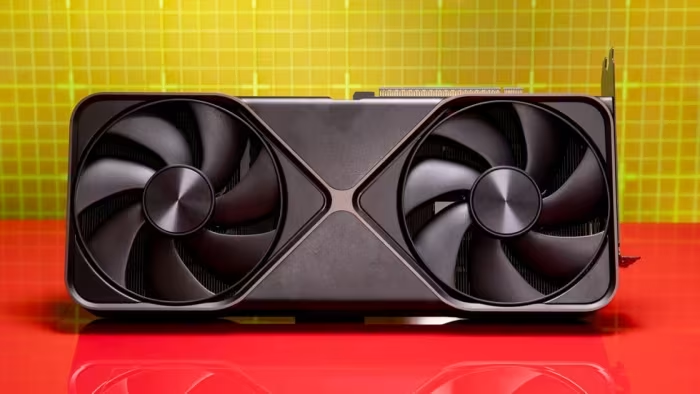
The Nvidia GeForce RTX 5090 is an elite-tier, Blackwell-architecture GPU designed for high-end gaming, AI, and professional content creation.
How This Score Is Calculated
- Sources analysed: 6 reviews
- Explicit scores: 0 sources (weighted 1.5×)
- Sentiment-only: 6 sources (weighted 1.0×)
- Split: 5 Positive · 1 Mixed · 0 Negative
- Raw weighted average: 8.8
- Formula: Σ(score × weight) ÷ Σ(weight)
- Consensus bonus +0.3: 83% sources agreed
- Final score: 8.8/10
Algorithmically calculated from source data. No manual adjustments.
- Most reviewed featurePerformance (6/6)
- Most praised32GB GDDR7 VRAM
- Most criticisedPower Consumption
- Reviewer consensus levelHigh
The Nvidia GeForce RTX 5090 sets a new benchmark for consumer graphics performance, leveraging the Blackwell architecture and 32GB of GDDR7 memory to outpace its predecessor significantly. While reviewers laud its class-leading rasterization and AI capabilities, the card is undeniably power-hungry and carries a prohibitive price tag. It is a specialized tool for enthusiasts and professionals rather than a practical choice for the average gamer.
🔧 Key Specifications
Specifications sourced from reviewer mentions. Verify with manufacturer for complete details.
- VRAM: 32GB GDDR7
- Architecture: Blackwell
- Power Limit: Up to 1000W (Lightning Z model)
- Connectivity: Thunderbolt 5 (Aorus AI Box variant)
- Cooling: AiO and custom plate options available
- Form Factor: Two-slot (Founders Edition)
💲 Price Range
1,67,500 INR – 4,25,000 INR
- Founders Edition: approx. 1,67,500 INR
- MSI Lightning Z: 4,25,000 INR
Prices sourced from reviews. Check current retailer pricing.
📊 What Reviewers Say — Feature by Feature
5 features evaluated across 6 sources.
👍 Key Strengths
- Unmatched rasterization performance
- Massive 32GB GDDR7 memory
- Excellent AI hardware stack
- Compact two-slot design
- Potent ray-tracing capabilities
👎 Key Weaknesses
- Prohibitively expensive pricing
- Extremely power hungry
- High latency with frame gen
- Requires high PSU overhead
💰 Value for Money Analysis
Reviewers view the RTX 5090 as an elite, symbolic product rather than a value proposition. With prices ranging from 1,67,500 INR to 4,25,000 INR, it is explicitly labelled as impractical for casual users.
4 of 6 sources commented on price or value.
⚡ Where Reviewers Disagreed
The following areas saw meaningful disagreement across sources.
- DLSS 4 Value: 1 source praised its perceived smoothness as worth the latency trade-off, while another warned that the latency makes it unsuitable for competitive gaming.
🎯 Who This Product Is For
Reviewer recommendations for different target audiences and use cases.
🛠️ Best Use Cases
- AI WorkloadsThe enhanced AI hardware stack and 32GB VRAM provide significant acceleration for machine learning tasks.Great
- High-End RenderingExcellent performance for 3D rendering and professional creative workflows.Great
- Competitive GamingWhile rasterization is fast, the latency added by frame generation tools makes it a poor choice for competitive titles.Poor
🔀 Alternatives Mentioned by Reviewers
Maximise this list. Include EVERY single competitor, rival, or alternative product mentioned in any of the source reviews. Do not omit any. More alternatives and longer lists are better.
- Nvidia GeForce RTX 4090 — The previous generation flagship. Reviewers note the 5090 is significantly faster, but the 4090 remains a powerful reference point for performance gains.
- Nvidia GeForce RTX 5080 — Cited by PCMag as the more realistic and fitting high-end choice for the vast majority of users who do not need the 5090's extreme capabilities.
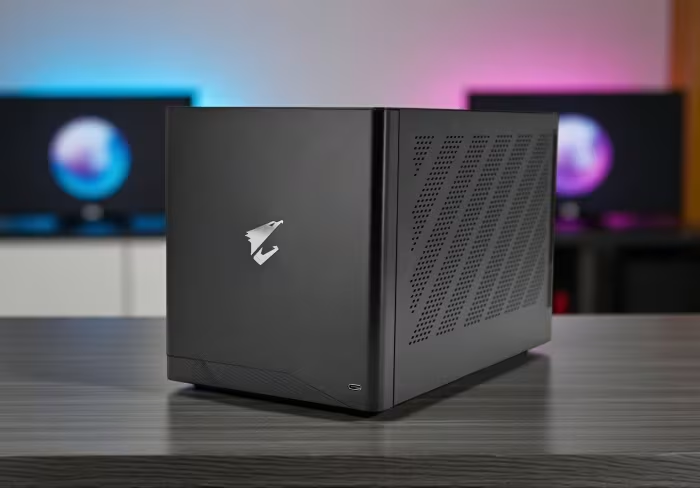
- Gigabyte Aorus RTX 5090 AI Box — An external GPU solution using Thunderbolt 5. It is less powerful than a desktop-installed 5090 but offers a compact, portable alternative for notebooks.
- AMD Radeon GPUs — Mentioned as a competitor that should be concerned by the performance gap established by the 5090's Blackwell architecture and software stack.
Alternatives sourced exclusively from reviewer mentions.
🛒 Buyer's Guide
✅ Buy This If…
- You are a professional content creator needing massive VRAM and AI compute.
- You are an enthusiast wanting the absolute pinnacle of current graphics technology.
- You require the specific rendering power for high-end professional workflows.
❌ Skip This If…
- You are a casual gamer; it is significant overkill and priced far too high.
- You play competitive shooters where latency from frame generation is unacceptable.
- You have a limited power supply; the card is extremely power-hungry.
⚠️ Things to Check Before Buying
- Ensure your PSU can handle the significant power overhead required by the card.
- Consider if the RTX 5080 meets your needs at a more reasonable price point.
- Be aware of the latency trade-offs if you plan on using DLSS 4 frame generation.
📈 Sentiment Trends Over Time
Reviews indicate a consensus on the hardware's dominance, with a shift in focus toward the software stack.
- Software Stack — DLSS 4 is increasingly viewed as a maturing, critical component of the value proposition, evolving from earlier iterations.
The Nvidia GeForce RTX 5090 is an unparalleled powerhouse that sets a new high-water mark for graphics performance. While its 32GB VRAM and Blackwell architecture are revolutionary for content creation, the exorbitant price and power requirements make it impractical for most gamers. If you are a professional or an extreme enthusiast, it is the best card money can buy. Otherwise, consider the RTX 5080 for a more balanced high-end experience.
Top Alternative: Nvidia GeForce RTX 5080 — A more realistic and fitting high-end choice for most users compared to the 5090.
Reviewer Perspectives & Source Breakdown
Review: Nvidia GeForce RTX 5090: An Editor’s Perspective - postPerspecti...
Price: Approximately ₹1,67,000
The Nvidia GeForce RTX 5090 is a powerful upgrade for multimedia creators, offering significant gains in AI processing and native 4:2:2 encoding support. It provides substantial performance improvements in professional workflows like DaVinci Resolve and Premiere Pro.
Pros
- Native 4:2:2 H.264/H.265 encoding and decoding support
- Large increase in CUDA and Tensor core counts
- Increased 32GB GDDR7 frame buffer memory
- Ultra-quiet fan operation under load
- Improved power connection design
Cons
- High total power requirement of 575W
Nvidia GeForce RTX 5090 Founders Edition Review | PCMag - pcmag.com...
Price: approx. 1,67,500 INR
The Nvidia GeForce RTX 5090 is an exceptionally powerful, elite-tier graphics card designed for content creators and high-end gaming. While it delivers unmatched performance, its prohibitive price makes it impractical for most casual gamers.
Pros
- Class-leading graphics performance
- Relatively compact two-slot design
- Powerful AI hardware capabilities
- Potent ray-tracing hardware
- 32GB of high-speed GDDR7 memory
- Efficient cooling performance
Cons
- Intimidating and expensive price point
- Extremely power-hungry hardware
Laptop power boost: Gigabyte Aorus RTX 5090 AI Box - External Nvidia GeF...
The Aorus RTX 5090 AI Box is a powerful, high-quality external GPU solution that leverages Thunderbolt 5 to significantly boost notebook performance. While it cannot match a desktop-installed RTX 5090, it offers an excellent, compact, and well-cooled package for users needing mobile AI or rendering power.
Pros
- Powerful Nvidia GeForce RTX 5090 with 32 GB VRAM
- High-quality, robust metal housing
- Compact and portable design
- Effective AiO cooling system
- Modern Thunderbolt 5 connectivity
Cons
- Audible fan noise under heavy load
- Performance lower than a native desktop RTX 5090
MSI GeForce RTX 5090 Lightning Z review – Lightning-fast and thirsty uni...
Price: 4,25,000 INR
The MSI GeForce RTX 5090 Lightning Z is an extreme, premium-priced GPU designed for collectors and overclockers seeking maximum power limits. It offers unmatched technical specifications, such as a 1000W TGP and 32GB GDDR7, prioritizing exclusivity and symbolic value over standard gaming efficiency.
Pros
- Extremely complex 40-phase power delivery system
- Massive 32GB GDDR7 memory configuration
- Integrated liquid cooling with full-cover plate
- Supports up to 1000 watts TGP
- High-quality premium build and construction
Cons
- Exorbitant symbolic pricing
- Inefficient for standard gaming use cases
- Requires significant power supply overhead
- Limited production availability
laptop power boost gigabyte aorus rtx 5090 ai box external nvidia geforc...
Pros
- + Nvidia GeForce RTX 5090 with 32 GB VRAM
- + high-quality metal housing
- + compact design
- + AiO cooling
- + Thunderbolt 5
Cons
- - audible under load
- - less performance than with a conventionally installed RTX 5090
Laptop power boost: Gigabyte Aorus RTX 5090 AI Box - External Nvidia GeF...
Pros
- + Nvidia GeForce RTX 5090 with 32 GB VRAM
- + high-quality metal housing
- + compact design
- + AiO cooling
- + Thunderbolt 5
Cons
- - audible under load
- - less performance than with a conventionally installed RTX 5090
nvidia geforce rtx 5090 review flawless or fake frames ProsCons...
So, the performance of NVIDIA’s new GPU is laid bare and accounts for DLSS 4, Frame Generation, Ray Tracing and straight rasterisation. But where does that leave me on the ‘Fake Frames’ debate, and what are my overall thoughts on the card? Let’s start with these so-called fake frames because my conclusion rests on that. There is no doubt that frame generation adds additional latency, especially at its most aggressive 4x setting. This is a bit of a mixed bag, as in Cyberpunk 2077, we saw a 16ms increase versus 2ms in Hogwarts Legacy. That, I would argue, makes it a setting you may want to avoid in titles like Apex Legends and Fortnite, whereby latency is of utmost importance.But, and I might be going out on a whim here, I actually think DLSS 4 is fantastic, and the latency trade-off is worth it for the increase in perceived game smoothness in the vast majority of titles. I turn the fake frames argument around and ask this: Would you rather NVIDIA added ever more VRAM and raw compute power to the GPU for, say, an extra 10% rasterisation performance or built an incredible software stack that increases efficiency and leverages centralised machined learning to deliver a far more sizeable, and far more noticeable, frame rate increase in your favourite title? The best bit is if DLSS 1, 2 and 3 are anything to go by – DLSS 4 will only get better. To be clear, I do want to see NVIDIA continue to deliver rasterised performance gains on a generation-by-generation basis – but it would be wrong to pretend they haven’t done this, too. The RTX 5090 delivers more performance than the RTX 4090 in our rasterised test suite and more in synthetic benchmarks too! Had the RTX 5090 been a repackaged RTX 4090 that only added the extra AI compute needed for DLSS 4 support, I would have been disappointed. But it isn’t, and the frenzy around fake frames frankly feels like it has gone a little far. NVIDIA’s software and hardware stack continues getting better, and if (and it’s a BIG if), the superb performance of the RTX 5090 is to set the tone for the remainder of the RTX 5090 lineup, AMD should be even more worried than they were just a few months back.
Pros
- ✅ Performance vs 4090
- ✅ Multi-frame gen
- ✅ Smaller form factor
Cons
- ❌ Expensive
- ❌ Latency with multi-frame gen
- ❌ Power hungry