Intel Core i7-6700K Review
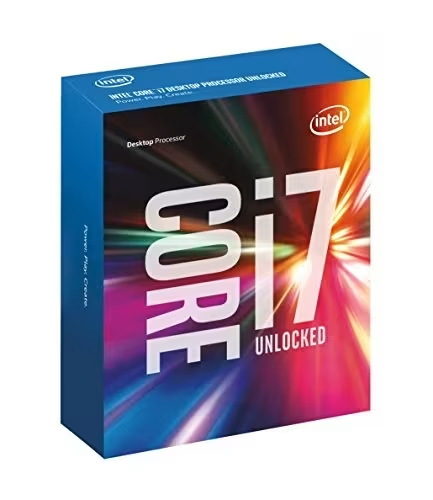
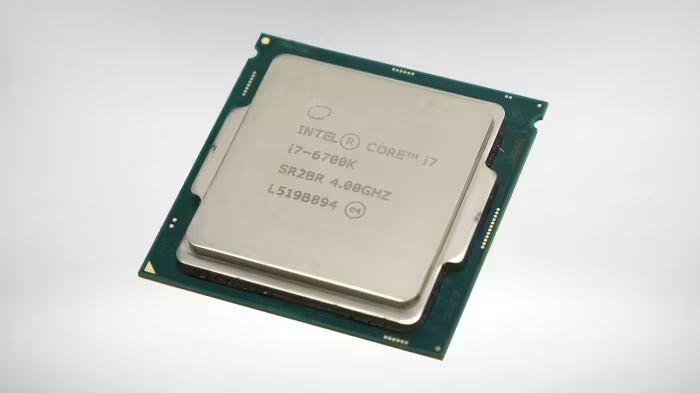
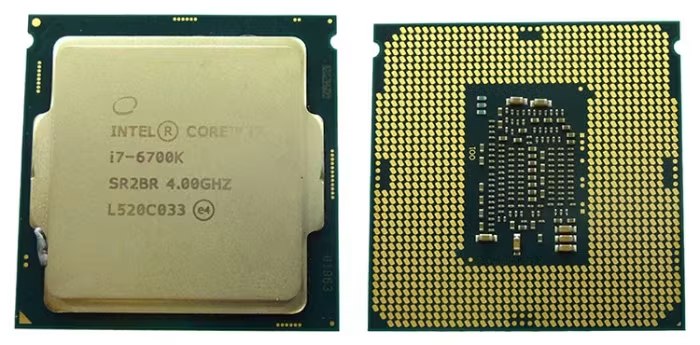
Intel Core i7-6700K
A quad-core Skylake enthusiast processor featuring an unlocked multiplier, support for DDR4 memory, and the Z170 chipset platform.
How This Score Is Calculated
- Sources analysed: 14 reviews
- Raw weighted average: 6.4/10
- Formula: Σ(score × weight) ÷ Σ(weight)
- Final score: 6.4/10 (clamped, rounded to 1 decimal)
Algorithmically calculated from source data. No manual adjustments.
- Most reviewed featurePerformance (14/14)
- Most praisedOverclocking potential
- Most criticisedMinimal generational gains
- Reviewer consensus levelModerate
- Value for moneyFair Value (6.2/10)
The Intel Core i7-6700K is a highly capable quad-core chip that offers strong single-threaded performance, making it a reliable choice for gaming and everyday productivity. However, reviewers widely note that it represents only an incremental improvement over the previous i7-4790K, with many benchmarks showing identical performance. While its overclocking potential and the modern Z170 platform features are praised, the requirement for a motherboard and RAM upgrade makes it a costly proposition for existing users.
🔧 Key Specifications
Specifications sourced from reviewer mentions. Verify with manufacturer for complete details.
- Architecture: Skylake (14nm)
- Cores/Threads: 4 Cores / 8 Threads
- Unlocked: Yes (K-Series)
- Memory Support: DDR4 and DDR3L
- Chipset: Z170
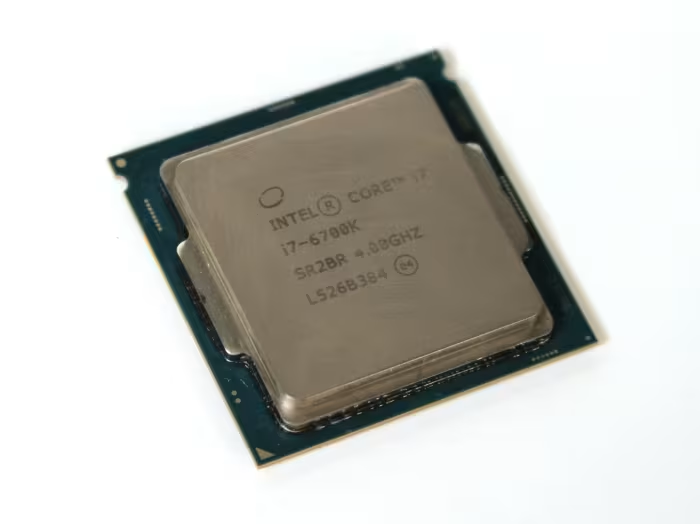
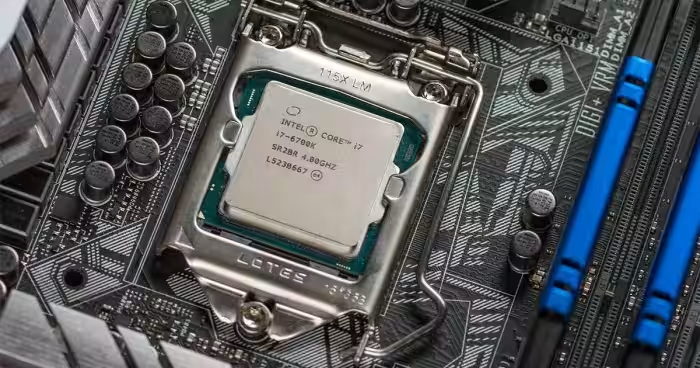
- Socket: LGA 1151
- Graphics: DX12-compatible integrated graphics
- PCIe: Extra lanes via Z170 chipset
💲 Price Range
₹10,800 – ₹29,500
Prices sourced from reviews. Check current retailer pricing.
📊 What Reviewers Say — Feature by Feature
8 features evaluated across 14 sources.
👍 Key Strengths
- Strong single-threaded performance
- Excellent overclocking flexibility
- Modern Z170 platform features
- Improved integrated graphics
- DDR4 memory support
👎 Key Weaknesses
- Minimal gains over i7-4790K
- Requires new motherboard and RAM
- Limited to four cores
- Expensive total system cost
- High heat at high overclocks
💰 Value for Money Analysis
Reviewers are divided on value; while the chip itself is priced competitively, the required platform transition (motherboard/RAM) makes it an expensive upgrade. It is often cited as a good enthusiast choice, but poor for those already on Haswell.
6 of 14 sources commented on price or value.
⚡ Where Reviewers Disagreed
The following areas saw meaningful disagreement across sources.
- Generational Performance Leap: 4 sources praised the 'tock' architectural improvements, while 6 sources explicitly criticised the lack of significant performance gains over the i7-4790K. This disagreement stems from whether reviewers tested specific memory-sensitive applications (where it wins) or general encoding/gaming (where it often ties).
🎯 Who This Product Is For
Reviewer recommendations for different target audiences and use cases.
🛠️ Best Use Cases
- GamingStrong single-threaded performance makes it a top-tier choice for gaming, though it offers no jump over the previous generation.Great
- Everyday ProductivityHighly capable for daily tasks and multitasking with 8 threads, though struggles with heavily multi-threaded professional workloads.Good
🔀 Alternatives Mentioned by Reviewers
Maximise this list. Include EVERY single competitor, rival, or alternative product mentioned in any of the source reviews. Do not omit any.
- Intel Core i7-4790K — The direct predecessor. Reviewers note it performs identically to the 6700K in most gaming and encoding tasks, making the 6700K a hard sell for current 4790K owners.
- Intel Core i7-5775C — Noted for significantly superior integrated graphics performance compared to the 6700K, though it is a different architectural beast.
- AMD A10-7870K — Outperforms the 6700K in integrated graphics gaming performance, making it a better choice for those specifically relying on iGPU gaming.
- AMD FX-9590 — Significantly outperformed by the 6700K in almost all benchmarks; generally considered a weaker alternative by reviewers.
- Core i5-6600K — Mentioned as a more budget-friendly Skylake alternative for those who don't need the full multi-threaded performance of the i7.
- Haswell-E Core i7-5960X — A high-end alternative; while the 6700K offers better performance-per-dollar, the 5960X is preferred for heavy multi-core professional workloads.
Alternatives sourced exclusively from reviewer mentions.
🛒 Buyer's Guide
✅ Buy This If…
- You are upgrading from a very old platform like Sandy Bridge or Ivy Bridge.
- You are an enthusiast who wants to experiment with overclocking on the Z170 platform.
- You are building a new high-end gaming PC and want the latest architecture.
❌ Skip This If…
- You already own an i7-4790K; the performance gains are negligible.
- You rely on heavily multi-threaded workloads; look for 6 or 8-core alternatives instead.
- You are on a strict budget and cannot justify the cost of a new motherboard and DDR4 RAM.
⚠️ Things to Check Before Buying
- Ensure you have a compatible LGA1151 motherboard; it is not backward compatible with older boards.
- Factor in the cost of DDR4 memory, as this is a required investment for this platform.
- Check your cooling solution; high overclocks cause significant heat increases.
📈 Sentiment Trends Over Time
Reviews span 2015 to 2026. The following changes were detected:
- Multi-threaded utility — While initially viewed as a top-tier enthusiast chip, long-term reviews highlight its struggle with modern, heavily multi-threaded workloads compared to newer multi-core standards.
Long-term impressions suggest the chip has aged into an entry-level gaming role rather than the enthusiast powerhouse it was marketed as at launch.
The Intel Core i7-6700K remains a capable processor for single-threaded tasks and gaming, but it is a difficult recommendation for those already on recent Intel platforms. While its overclocking potential and the Z170 chipset are highlights, the minimal performance jump over the 4790K and the high cost of a platform upgrade limit its overall appeal. If you are building a new system from scratch, it is a solid choice, but existing Haswell users should look elsewhere.
Top Alternative: Intel Core i7-4790K — If you already own this chip, stick with it as the 6700K offers almost no tangible performance increase.
Reviewer Perspectives & Source Breakdown
Intel Core i7-6700K Skylake CPU Review > DDR4-2666 vs. DDR4-3000 | TechS...
The Intel Core i7-6700K shows significant performance gains in memory-sensitive applications when paired with faster DDR4-3000 memory. While it matches or outperforms its predecessor in several tasks, it still trails behind in certain specific benchmarks like 7-zip.
Pros
- 29% boost in memory bandwidth with DDR4-3000
- 12% performance increase in Adobe Photoshop CC
- Matches 4790K performance in Excel 2013
Cons
- Little impact on Cinebench R15 scores
- Noticeably slower than 4790K in 7-zip benchmark
Review: Intel Core i7-6700K (14nm Skylake) - CPU - HEXUS.net - Page 10 -...
Overclocking the processor to 4.6GHz yields a 10% performance boost but significantly increases power consumption and heat. The marginal gains do not justify the trade-off for gaming purposes.
Pros
- Stable overclocking up to 4.6GHz possible
- Provides 10 percent performance improvement
Cons
- Increased system-wide power consumption
- Higher under-load operating temperatures
- Performance gains insufficient for gaming
Intel Core i7-6700K Skylake CPU Review > Encoding Performance | TechSpot...
The Core i7-6700K delivers performance identical to its predecessor, the 4790K, across most encoding benchmarks. It shows no significant generational performance leap in these specific tasks.
Pros
Cons
- No significant progress over previous generation
- Performance is identical to 4790K
Intel Core i7-6700K Skylake CPU Review > iGPU Gaming Performance | TechS...
The Core i7-6700K provides a significant performance boost over the previous generation i7-4790K in iGPU gaming. However, it still lags significantly behind the Core i7-5775C in graphical performance.
Pros
- 20% to 40% faster than i7-4790K
- Delivers playable frame rates in several gaming titles
Cons
- Significantly slower than the Core i7-5775C
- Outperformed by AMD A10-7870K in iGPU tasks
Intel Core i7-6700K Skylake CPU Review > dGPU Gaming Performance | TechS...
The Core i7-6700K shows no performance improvement in gaming compared to its predecessor. It is not a significant upgrade for gamers.
Pros
Cons
- No performance gain over the previous generation
- Disappointing results in gaming benchmarks
Intel Core i7-6700K Skylake CPU Review > Power Consumption | TechSpot - ...
The i7-6700K offers disappointing performance gains and marginal power efficiency improvements compared to the predecessor i7-4790K.
Pros
- Lower power consumption than i7-4790K
Cons
- Lack of performance gains
- Slower performance in some tests than i7-4790K
- Marginal efficiency improvements
Review: Intel Core i7-6700K (14nm Skylake) - CPU - HEXUS.net - hexus.net...
Price: Approximately ₹27,500
The Intel Core i7-6700K is a capable processor using the Skylake architecture, though it offers incremental performance gains over previous generations. It requires a new platform transition, including an LGA1151 motherboard and DDR4 memory.
Pros
- Improved instructions-per-clock performance
- Support for DDR4 memory
- Enhanced Z170 chipset with more PCIe 3.0 lanes
- Upgraded DMI 3.0 interface
Cons
- Requires new motherboard and DDR4 RAM
- Lower clock speed than Core i7-4790K
- Limited initial processor rollout
Intel Skylake review: Core i7-6700K and Core i5-6600K - Trusted Reviews ...
These processors offer a solid performance upgrade over Haswell with improved power efficiency and overclocking potential. However, they lack groundbreaking new features and require investments in new motherboards and memory.
Pros
- Excellent overall performance
- Noticeable upgrade over Haswell
- Big jump in graphics performance
- Slightly more power efficient than Haswell
- Excellent overclocking options
Cons
- Needs a new motherboard and memory
- Expensive if you don't need the overclocking
- Graphics still not good enough for serious gaming
Intel Core i7-6700K Skylake CPU Review | TechSpot - techspot.com...
Price: Approx. ₹22,500 for i7-6700K; Approx. ₹15,500 for i5-6600K
The Skylake processors represent a significant 'tock' architectural update, offering modest performance gains over Haswell and support for DDR4 memory. However, they require a new LGA1151 motherboard, making upgrades more expensive for existing users.
Pros
- Improved CPU and GPU performance over previous generations
- Support for both DDR3L and DDR4 memory standards
- Architectural improvements via 'tock' release cycle
Cons
- Requires a new LGA1151 socket motherboard
- Not backward compatible with 9-series motherboards
- Limited supply expected at launch
Page 1 of 2