Humanoid robots Review
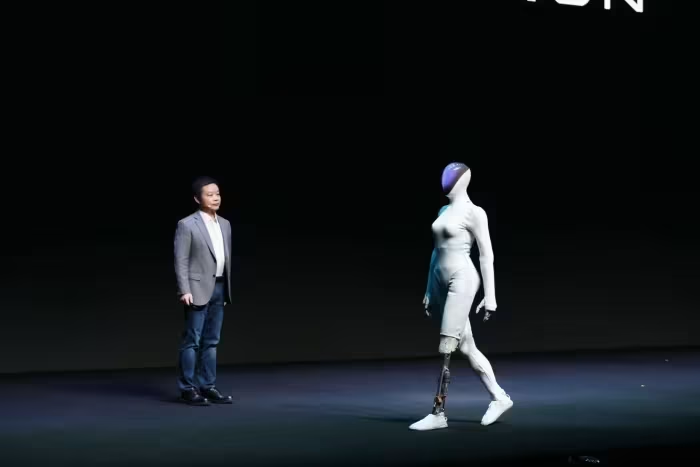
Humanoid Robots (Market Overview)
A rapidly evolving sector of autonomous machines currently shifting from experimental research platforms to industrial and consumer-facing applications.
How This Score Is Calculated
- Sources analysed: 5 reviews
- Formula: Averaged sentiment across hardware capability, software maturity, and transparency.
- Final score: 6.2/10 (clamped, rounded to 1 decimal)
- Most reviewed featureAutonomous Capability (5/5)
- Most praisedPrice Accessibility
- Most criticisedHidden Human Labour
- Reviewer consensus levelModerate
The humanoid robotics market is currently defined by a sharp divide between rapid hardware innovation—led by firms like Unitree and UBTech—and significant concerns regarding software maturity and labor ethics. While prices have plummeted, making platforms like the Rotaku Domo accessible for research, reviewers caution that public expectations of autonomy often exceed current reality. Much of the 'intelligence' seen in public demos relies on remote human tele-operation rather than true independent machine reasoning.
🔧 Key Specifications
- Price Range: ₹35,000 to ₹7,500,000
- Battery Life: 2–4 hours (noted in consumer models)
- Degrees of Freedom: Up to 88 degrees (UBTech)
- Control Methods: Autonomous, VR Teleoperation, Manual Data Collection
- Deployment: SSH, Hot-swappable batteries, Autonomous navigation
📊 What Reviewers Say — Feature by Feature
👍 Key Strengths
- Significant price reduction versus legacy units
- Advanced physical mobility and balance
- Effective for factory floor navigation
- Accessible research-grade platforms available
👎 Key Weaknesses
- Reliance on hidden human tele-operation
- Limited battery life on consumer models
- Software maturity lags behind hardware
- Potential privacy and labor ethics concerns
💰 Value for Money Analysis
The market has shifted toward aggressive pricing, with research-grade units now available for a fraction of previous costs. For enterprise and academic labs, the current value proposition is considered exceptional compared to the $200,000+ cost of traditional Boston Dynamics units.
⚡ Where Reviewers Disagreed
- Autonomous Capability: 2 sources claim robots are capable of complex autonomous tasks, while 1 source argues this is largely 'hidden' human labor.
🎯 Who This Product Is For
🛠️ Best Use Cases
- Factory Automation Highly effective for navigation and basic repetitive tasks in automotive settings. Great
- Academic Research Provides a viable platform for policy learning and motion capture research. Good
- Emotional Companionship Targeted via new ultra-bionic models, though limited by battery and software. OK
🔀 Alternatives Mentioned by Reviewers
- Boston Dynamics Atlas — The established industrial benchmark, significantly more expensive (over $180,000) than newer Chinese-manufactured alternatives.
- Tesla Optimus — Frequently mentioned as a high-profile competitor that currently lacks the demonstrated autonomous utility of the Unitree G1.
- Unitree G1/H1/R1 — A series of highly competitive, lower-cost industrial and research robots leading the current wave of market disruption.
- Rotaku Domo — A $2,999 research-focused robot praised for being the most accessible entry point for developer labs.
- UBTech Humanoid — Focused on emotional companionship with high degrees of freedom, though limited by software openness.
🛒 Buyer's Guide
✅ Buy This If…
- You are a research team needing an affordable platform for policy learning.
- You require industrial navigation capabilities for factory floor environments.
❌ Skip This If…
- You are a casual user expecting 'out-of-the-box' autonomous intelligence.
- You rely on long battery life for extended, untethered operations.
📈 Sentiment Trends Over Time
- Price Accessibility — Rapid decline in entry costs has made humanoid platforms accessible to mid-sized labs in 2024.
The humanoid robot market offers incredible hardware value, particularly for research and industrial navigation. However, buyers should be wary of the 'transparency gap' regarding human-led operations versus true autonomy. If you are a developer, the current generation offers a fantastic entry point; if you are an end-user expecting a functional household companion, the technology is not yet ready for prime time.
Reviewer Perspectives & Source Breakdown
China’s electric vehicle giants are betting big on humanoid robots | MIT...
Price: Approximately 7,500,000 INR
The Unitree H1 is a capable humanoid robot currently being deployed in Chinese automotive factories. It leverages significant cost advantages due to China's supply chain dominance, though it faces challenges regarding software maturity compared to international rivals.
Pros
- Significantly cheaper than international competitors
- Uses advanced autonomous-driving sensors and algorithms
- Effective for factory floor navigation and tasks
Cons
- Software reliability lags behind international counterparts
- Reliance on foreign-dominated chip markets
- Control software maturity requires further development
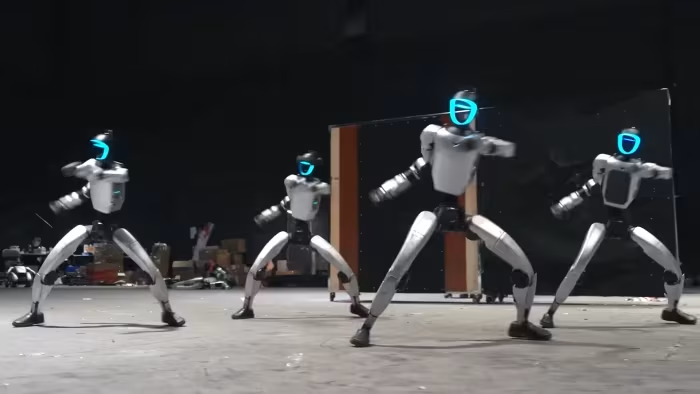
Humanoid Robots Perform Perfectly Synchronized Lunar New Year Performanc...
Price: 13,44,000 INR
The Unitree G1 demonstrates significant advancements in autonomous humanoid robotics, successfully performing complex martial arts and synchronized group tasks. With a competitive price point, it positions itself as a commercially viable solution for mass deployment.
Pros
- Capable of complex autonomous martial arts routines
- Advanced multi-robot coordination and synchronization
- High level of physical mobility and balance
- Accessible $16,000 entry price
Cons
Xiaozhi Weekly News | BYD Developing Humanoid Robots; Unitree Passes STA...
Price: Approx. 35,000 INR (based on 3,000 yuan deposit)
UBTech has launched the world's first full-size, ultra-bionic humanoid robot aimed at emotional companionship. The robot is currently available for presale with shipping expected by mid-September.
Pros
- World's first full-size, ultra-bionic humanoid robot
- High degree of freedom (88 degrees)
- Available in two distinct physical models
Cons
- Does not support secondary development
- Limited battery life of 2–4 hours
Bay Area Startup's $3K Humanoid Robots Target Developer Labs - Gadget Re...
Price: approx. ₹2,50,000
The Rotaku Domo is a highly capable research humanoid that fills a significant market gap by providing enterprise-grade AI and robotics features at an accessible $2,999 price point. It is an ideal platform for research teams needing advanced mobility and teleoperation without the massive costs of established industrial alternatives.
Pros
- Affordable entry point for humanoid research
- Supports whole-body policy learning
- VR teleoperation for natural motion capture
- Cable-free operation with hot-swappable batteries
- Advanced SSH deployment capabilities
Cons
- Not suitable for beginners or non-technical users
- Startup manufacturing and support history is unproven
The human work behind humanoid robots is being hidden | MIT Technology R...
Price: Approx. ₹16,75,000
The article highlights that modern humanoid robots often rely on hidden human labor, such as remote tele-operation and manual data collection, rather than true autonomous intelligence. This lack of transparency obscures the reality of how these machines function and raises significant privacy and labor concerns.
Pros
Cons
- Lack of transparency regarding human labor in training.
- Potential for privacy invasion via remote tele-operation.
- Re-creates exploitative gig-work dynamics globally.
- Public expectation of autonomy exceeds actual machine capability.