Graphics cards Review

2026 Graphics Card Landscape
A comprehensive overview of recent GPU releases, ranging from workstation-focused Intel Arc solutions to high-end NVIDIA and AMD gaming cards.
How This Score Is Calculated
- Sources analysed: 7 reviews
- Sentiment-only: 7 sources (weighted 1.0×)
- Split: 5 Positive · 2 Mixed · 0 Negative
- Raw weighted average: 7.4
- Review period: April 2026
Algorithmically calculated from source data. No manual adjustments.
- Most reviewed featurePerformance (7/7)
- Most praisedOptimization
- Most criticisedTechnical Bugs
- Reviewer consensus levelModerate
The current graphics card market offers distinct paths for professionals and gamers. While Intel's Arc Pro series targets specialized workstation needs with low-profile designs, NVIDIA and AMD continue to dominate the gaming space with high-performance 4K and 1440p solutions. Reviewers highlight excellent software optimization in new PC titles, though technical bugs and high energy demands remain persistent concerns across the board.
🔧 Key Specifications
Specifications sourced from reviewer mentions.
- Intel Arc Pro B50: Low-profile workstation GPU, 4 monitor outputs
- NVIDIA RTX 5080: 4K gaming focus, DLSS 4 support, $999 MSRP
- AMD RX 7800 XT / 7700 XT: RDNA 3, FSR 3 support, 1440p focus
💲 Price Range
₹37,500 – ₹83,500 (approximate street pricing)
Prices sourced from reviews. Check current retailer pricing.
📊 What Reviewers Say — Feature by Feature
3 features evaluated across 7 sources.
👍 Key Strengths
- Excellent 4K/1440p performance
- Effective DLSS 4 and FSR 3
- Low-profile workstation options
- Solid generational jumps
👎 Key Weaknesses
- High energy draw on flagships
- Technical bugs in new games
- Anti-Lag+ and frame gen stutters
- Tricky bracket mounting on B50
💰 Value for Money Analysis
The RX 7800 XT is highlighted as an excellent value-to-performance choice. The RTX 5080 is considered a practical alternative to the much more expensive RTX 5090.
3 of 7 sources commented on price or value.
⚡ Where Reviewers Disagreed
The following areas saw meaningful disagreement across sources.
- Performance Consistency: 2 sources praised specific card performance while 1 source noted stuttering issues with frame generation and Anti-Lag+ features.
🎯 Who This Product Is For
Reviewer recommendations for different target audiences.
🛠️ Best Use Cases
- 1440p GamingThe RX 7800/7700 XT series is ideal for high-fidelity 1440p performance.Great
- AI WorkloadsIntel Arc Pro series provides sufficient VRAM for running AI models in a professional capacity.Good
🔀 Alternatives Mentioned by Reviewers
Maximise this list. Include EVERY single competitor, rival, or alternative product mentioned in any of the source reviews.
- NVIDIA RTX 5090 — Cited as the significantly more expensive flagship; reviewers suggest the RTX 5080 as a more practical value alternative for most gamers.
- AMD RX 6800 XT — Used as a performance parity benchmark for the RX 7800 XT; the newer 7800 XT is preferred due to a much lower price point.
- AMD RX 6700 XT — The previous generation card against which the RX 7700 XT shows significant performance gains.
- NVIDIA RTX 4080 Super — The predecessor to the RTX 5080; the new card offers only a modest performance increase over this model.
Alternatives sourced exclusively from reviewer mentions.
🛒 Buyer's Guide
✅ Buy This If…
- You need a low-profile GPU for a workstation PC.
- You are upgrading from an older generation card like the 6700 XT.
- You want 4K gaming without paying the RTX 5090 premium.
❌ Skip This If…
- You are a casual user who doesn't need dedicated graphics.
- You are concerned about high energy consumption in a small build.
⚠️ Things to Check Before Buying
- Verify bracket compatibility for low-profile workstation cards.
- Check game compatibility for specific features like Anti-Lag+ in multiplayer.
📈 Sentiment Trends Over Time
Reviews span April 2026. The following changes were detected:
- Software Optimization — Games are moving away from heavy upscaling reliance toward better native optimization.
The current GPU market offers strong options tailored to specific needs, from Intel's workstation-grade Arc Pro series to NVIDIA's high-end gaming flagships. While performance gains are often incremental, the improved efficiency of upscaling technologies like DLSS 4 and FSR 3 makes modern cards compelling. Gamers should prioritize the RX 7800 XT or RTX 5080 for the best balance of price and performance, while professionals should look toward the Intel Arc Pro line for specialized workstation tasks.
Reviewer Perspectives & Source Breakdown
Intel Will Reportedly Launch Its "Big Battlemage" Arc Pro B70 and B65 Wo...
Intel is launching its new 'Big Battlemage' Arc Pro B70 and B65 workstation graphics cards, focusing on professional workloads rather than consumer gaming. These cards feature significant VRAM configurations but remain aimed at OEM partners instead of retail gamers.
Pros
- High VRAM capacity
- Professional-grade workstation optimization
- Shared driver support for gaming capability
Cons
- Not marketed as consumer gaming cards
- Availability limited to OEM workstation channels
- Uncertainty regarding consumer-grade Battlemage availability
Nvidia RTX 5080 review: the new 4K gaming king of graphics cards - thesh...
Price: approx. ₹83,500
The Nvidia RTX 5080 is a strong choice for high-end 4K gaming, offering impressive performance and DLSS 4 features at a $999 price point. While it relies heavily on frame generation, it provides a more practical value proposition for most gamers compared to the significantly more expensive RTX 5090.
Pros
- Drives 4K 60fps for most games
- Multi-Frame Generation enables 4K 120fps
- DLSS 4 Transformer Model improves image quality
- No price increase over RTX 4080 Super
Cons
- Higher energy draw than the RTX 4080
- MFG can produce noticeable stuttering
- Moderate to small performance increase over RTX 4080
Review of the AMD Radeon RX 7800 XT and Radeon RX 7700 XT Midrange, Enth...
Price: Approximately ₹37,500 to ₹41,500
These RDNA 3-based GPUs offer strong 1440p gaming performance and modern features like FSR 3. The 7700 XT provides a solid generational jump, while the 7800 XT delivers excellent value compared to previous high-end models.
Pros
- Improved raytracing performance
- Hardware-accelerated AV1 encoding support
- Effective performance gains with FSR 3
- Competitive launch pricing
Cons
- Anti-Lag+ issues in multiplayer games
- Fluid Motion Frames stutters during rapid movement
- 7800 XT does not significantly outperform RX 6800 XT
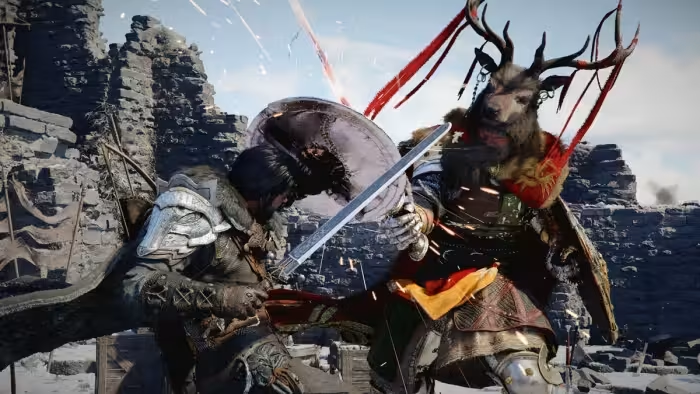
Crimson Desert PC Performance Review: I Tested All the Recommended Graph...
Crimson Desert is a visually impressive open-world game that is surprisingly well-optimized for a wide range of PC hardware. While it features ambitious mechanics, the experience is hindered by tedious combat, poor storytelling, and technical bugs.
Pros
- Well-optimized for various hardware configurations
- Visually beautiful open world
- Upscaling features perform as intended
- Runs surprisingly well on low-end hardware
Cons
- Tedious combat encounters
- Unintuitive puzzles
- Awful story
- Substantial bugs throughout the game
Crimson Desert PC Performance Review: I Tested All the Recommended Graph...
Crimson Desert is a well-optimized PC game that performs impressively across various hardware tiers. While the game itself has design flaws, its technical performance exceeds developer estimates.
Pros
- Surprisingly well-optimized for various hardware configurations
- Upscaling features effectively enhance quality and performance
- Maintains playable frame rates even on low-end hardware
Cons
- Combat and puzzles can feel tedious
- Game suffers from significant bugs and unintuitive design
- Does not currently run on SteamOS handhelds
Crimson Desert PC Performance Review: I Tested All the Recommended Graph...
Crimson Desert is a surprisingly well-optimized game that runs smoothly across a wide range of hardware without being overly dependent on upscaling. While the game itself features ambitious design, it is hampered by bugs, tedious combat, and an unintuitive story.
Pros
- Well-optimized performance across various hardware
- Upscaling features serve as enhancement rather than requirement
- Visually beautiful open-world environments
- Accessible performance even on lower-end graphics cards
Cons
- Contains significant bugs and technical issues
- Combat encounters can feel tedious
- Story and puzzles are unintuitive
- Requires high-end hardware for maximum settings
intels new arc pro b50 is a fresh challenger in the graphics arenabyian ...
With its low-profile casing and gentle power draw, the Intel Arc Pro B50 may find its way into many smaller workstation PCs. It?s a great upgrade over integrated graphics and has plenty of VRAM for running AI models, but it doesn?t produce the same rendering results as rival cards, some of which can be cheaper too.
Pros
- Low profile
- Low power consumption
- Four monitor outputs
Cons
- Costs more than a gaming card
- And it's less powerful
- Bracket tricky to change