Framework Desktop Review

Framework Desktop
A compact, modular small-form-factor PC featuring AMD Strix Halo architecture, designed for enthusiasts valuing efficiency and customization.
How This Score Is Calculated
- Sources analysed: 13 reviews
- Raw weighted average: 6.8/10
- Formula: Σ(score × weight) ÷ Σ(weight)
- Value sources: 8 of 13 mentioned price or value
- Final score: 6.8/10 (rounded)
- Most reviewed featureModularity (11/13)
- Most praisedPerformance/Efficiency
- Most criticisedSoldered RAM/Limited Upgradeability
- Reviewer consensus levelModerate
- Value for moneyFair Value (5.8/10)
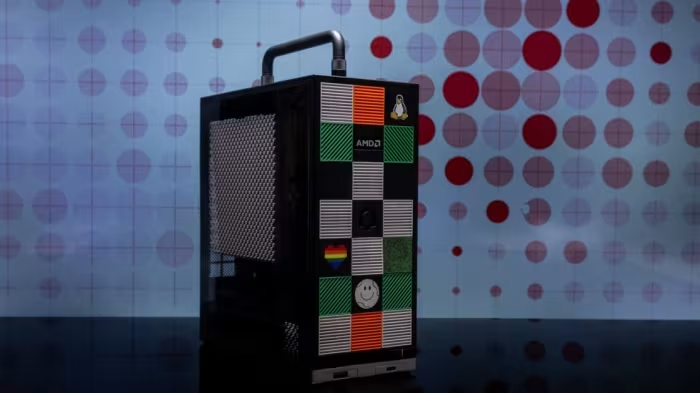
The Framework Desktop is a polarizing yet impressive piece of hardware that blends high-performance AMD Strix Halo silicon with a unique, modular chassis. While it excels in energy efficiency, quiet operation, and aesthetic customization, it frequently struggles to justify its premium price point compared to traditional DIY builds. It is best suited for power users who prioritize a compact footprint and Linux compatibility over the raw cost-to-performance ratio of standard desktop towers.
🔧 Key Specifications
- Processor: AMD Ryzen AI Max Plus 395 (Strix Halo)
- Graphics: 8060S Integrated GPU
- RAM: Soldered (Not user-upgradable)
- Cooling: Standard industry parts with included NVMe heatsinks
- Power: Integrated PSU (supports up to 240W via USB-C)
- OS: User-defined (Linux-friendly)
- Expandability: Modular Expansion Cards
💲 Price Range
₹92,000 – ₹2,10,000
Prices sourced from reviews. Check current retailer pricing.
📊 What Reviewers Say — Feature by Feature
7 features evaluated across 13 sources.
👍 Key Strengths
- Powerful AMD Strix Halo APU performance
- Quiet and cool under load
- Compact and efficient design
- Excellent Linux-friendly hardware compatibility
- Unique modular aesthetic customization
👎 Key Weaknesses
- Soldered RAM prevents future upgrades
- Premium price for limited expansion
- Front port access and speed limitations
- Expensive cosmetic tile accessories
- Assembly errors possible by users
💰 Value for Money Analysis
The Framework Desktop is widely viewed as a "niche" enthusiast product rather than a value-driven one. Reviewers consistently note that for the same price, a custom-built PC offers significantly more performance and flexibility.
8 of 13 sources commented on price or value.
⚡ Where Reviewers Disagreed
The following areas saw meaningful disagreement across sources.
- Modularity Value: 7 sources praised the modularity as a core benefit, while 6 sources argued that the soldered components make it feel like a "fake" modular product compared to Framework laptops.
🎯 Who This Product Is For
🛠️ Best Use Cases
- AI Workloads The Strix Halo silicon handles large language models and AI tasks efficiently in a compact footprint. Great
- 1080p/1440p Gaming Performance is solid for moderate gaming, though it lacks the raw power of dedicated discrete GPUs. Good
- General Productivity The quiet operation and small size make it an excellent, unobtrusive workstation. Great
🔀 Alternatives Mentioned by Reviewers
- Minisforum S1-Max — A more affordable, turnkey mini-PC solution that offers better out-of-the-box convenience for general users.
- Minisforum AI X1 Pro — Offers competitive AI performance in a smaller package, often at a more attractive price point.
- MSI NUC AI+ 2MG — A direct mini-PC competitor that the Framework Desktop generally outperforms, though with less modularity.
- Geekom IT15 — A standard mini-PC alternative that is generally considered less powerful than the Framework model.
- Lenovo Legion Tower 5 — A traditional gaming tower recommended for those who prioritize raw gaming power and standard upgradeability over compact size.
- M4 Max Mac Studio — A high-end workstation alternative that matches the Framework's performance but at a much higher price point.
- Traditional DIY Mini-ITX Builds — Reviewers consistently suggest that building your own custom PC provides superior upgradeability and performance for the same total cost.
✅ Buy This If…
- You prioritize a compact, quiet, and aesthetically pleasing workstation.
- You are a Linux user seeking hardware with excellent driver support.
- You value the modular design and the ability to swap aesthetic front tiles.
❌ Skip This If…
- You are looking for a gaming PC, as discrete GPUs provide better value.
- You require long-term upgradeability for RAM or the CPU.
- You are on a strict budget and want the highest performance-per-dollar.
⚠️ Things to Check Before Buying
- Ensure you understand that RAM is soldered and cannot be upgraded later.
- Check for regional availability, as shipping is limited to specific areas.
- Factor in the cost of additional cosmetic tiles and potentially a power supply cable.
The Framework Desktop is a technically impressive and beautifully designed machine that succeeds as a niche, high-efficiency workstation. While its modular branding feels slightly undermined by soldered components, it remains a fantastic choice for users who value a small footprint and Linux-friendly performance. However, for those seeking a pure gaming rig or maximum long-term upgradeability, a standard custom-built tower remains the superior choice. If you value design and efficiency over pure value, it is a rewarding purchase.
Top Alternative: Traditional DIY Mini-ITX Builds — Choose this if you want the best possible performance, repairability, and value for your money.
Reviewer Perspectives & Source Breakdown
Framework Desktop review | IT Pro - itpro.com...
Price: Approximately ₹1,34,000
The Framework Desktop is a powerful, highly modular small-form-factor PC that delivers exceptional performance for its price. Despite some minor ergonomic issues with front-facing ports and non-upgradable RAM, its build quality and versatility make it a top-tier choice.
Pros
- Seriously powerful performance
- Available in barebones configuration
- Inventive and modular design
- Excellent selection of physical ports
- Clever, swappable expansion cards
Cons
- RAM cannot be upgraded after purchase
- Front ports are difficult to access
- Decorative tiles are an expensive cosmetic extra
Framework Desktop Power Mode Tuning For Better Performance Or Power Effi...
The article analyzes the impact of power modes on the Framework Desktop equipped with the AMD Ryzen AI Max+ 395 SoC. It quantifies how switching between power saver, balanced, and performance modes affects CPU thermals, power consumption, and overall system efficiency under Linux.
Pros
- Easy adjustment via GNOME desktop
- Detailed analysis of power and thermal impact
- Comprehensive Linux-based performance benchmarking
Cons
Framework Desktop review: AMD's Strix Halo in a petite, powerful, pricey...
Price: Approximately ₹1,34,000
The Framework Desktop is a charming and highly compact system with solid 1080p gaming performance. However, its high price tag makes it difficult to recommend over traditional gaming rigs that offer discrete graphics.
Pros
- Strong 1080p performance on integrated graphics
- Fun and customizable design
- Small footprint fits easily on a desk
Cons
- Expensive
- Required to buy tiles to decorate the chassis
- PSU cable not included
- Not as upgradeable as traditional desktops
Framework Desktop (2025) Review: Powerful, but perhaps not for everyone ...
Price: Approximately ₹92,000 to ₹1,91,000
The Framework Desktop is a powerful, compact, and efficient workstation that offers impressive performance for creative and AI tasks. However, its use of a soldered APU and RAM undermines the brand's core ethos of modularity and repairability.
Pros
- Powerful APU performance
- Compact and efficient design
- Easy to set up and use
- Compatible with other Mini-ITX cases
Cons
- APU and RAM are soldered to the mainboard
- Lacks the signature repairability of other Framework products
- Base price requires additional purchases for a complete system
Framework Desktop Review A Solid AMD Strix Halo - ServeTheHome - serveth...
Price: Approximately ₹2,10,000 ($2500)
The Framework Desktop offers a unique, modular building experience, but the manual assembly requirement and high total cost make it less competitive than turnkey alternatives. It is a niche choice for enthusiasts who value customization over out-of-the-box convenience.
Pros
- High level of hardware customization
- Excellent, user-friendly BIOS interface
- Included NVMe heatsinks for all slots
- 128GB RAM configuration is competitive given DDR5 prices
Cons
- Requires significant time for manual assembly
- Only two front-facing expansion card slots
- Risk of assembly errors by the user
- Flaky USB4 and mDP multi-monitor support
- Poor availability due to limited shipping regions
A Deep Dive Into The Power & Thermals For The Framework Desktop With AMD...
The Framework Desktop with AMD Ryzen AI Max is a highly capable and energy-efficient mini PC that offers superior performance compared to Intel Core Ultra 9 systems. It remains quiet even under load, making it an excellent Linux-friendly workstation.
Pros
- Powerful AMD Ryzen AI Max Strix Halo performance
- Excellent energy efficiency
- Quiet operation even under heavy workloads
- Linux-friendly hardware compatibility
Cons
Review: Framework Desktop is a mash-up of a regular desktop PC and the M...
The Framework Desktop is a curious product that offers solid design and modularity, yet struggles to justify itself against standard self-built PCs. While it is better than no-name mini desktops, it prioritizes a small form factor over the superior upgradeability and performance of custom-built machines.
Pros
- Compact and space-saving design
- Easy and well-documented assembly process
- Includes helpful screwdriver and clear instructions
- Uses standard industry parts for cooling
- Magnetic panels allow for easy customization
Cons
- Less upgradeable than standard custom-built PCs
- Lower performance compared to traditional desktop builds
- Price premium for limited expansion capabilities
- Front USB ports have speed limitations
- Display outputs not supported on front expansion cards
Framework Desktop Review: Small and Mighty, but Shy of Upgrade Greatness...
Price: Approx. ₹95,000 to ₹205,000
The Framework Desktop is a compact, surprisingly powerful machine that offers impressive sustained performance, though it lacks the user-friendly upgradeability expected from the brand. It is an efficient choice for specific AI workloads, but traditional desktop builders may find better value elsewhere.
Pros
- Very impressive integrated GPU
- Strong, sustainable performance
- Compact footprint
Cons
- Less upgradeable than most desktop PCs
- Kind of cheap-feeling case
Framework Desktop Review: This Mighty Mini PC Has Modular Mojo, CPU Go-G...
Price: ₹92,000 (approx. $1,099)
The Framework Desktop is a pint-size, highly capable PC that shines in productivity, AI, and moderate gaming thanks to its unique Ryzen AI Max processor. While its modularity is less revolutionary for desktops than for laptops, it remains an appealing choice for DIY enthusiasts and early adopters.
Pros
- Super-compact Mini-ITX design
- Admirable AMD Strix Halo processor and graphics performance
- Functionally and aesthetically customizable
- Supports bringing your own parts and OS
Cons
- Comparable gaming PCs offer more power for the price
- Modularity feels less impactful than on Framework laptops
Page 1 of 2