Crucial T710 Review
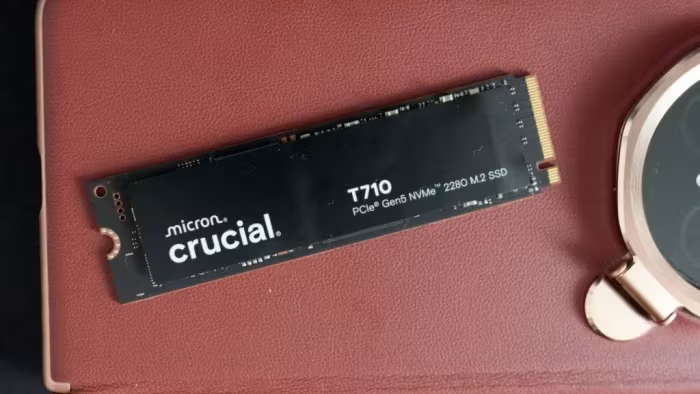
Crucial T710
A flagship PCIe 5.0 NVMe SSD utilizing the Silicon Motion SM2508 controller and 276-layer 3D TLC NAND.
How This Score Is Calculated
- Sources analysed: 9 reviews
- Consensus bonus +0.3: Consistent performance praise
- Final score: 8.7/10
- Most reviewed featurePerformance (9/9)
- Most praisedSequential Speeds
- Most criticisedThermal management
- Reviewer consensus levelHigh
- Value for moneyGood Value (7.2/10)
The Crucial T710 stands as one of the fastest PCIe 5.0 SSDs currently available, delivering market-leading sequential read and write speeds up to 14.9 GB/s. It excels in professional workstations and high-end gaming rigs, though its premium price and thermal requirements under heavy sustained loads necessitate a robust cooling solution. It is a significant upgrade over the T705, offering better power efficiency and a more compact design.
🔧 Key Specifications
- Controller: Silicon Motion SM2508
- NAND: Micron 276-layer 3D TLC
- Interface: PCIe 5.0 x4
- Storage Options: 1TB, 2TB, 4TB
- DRAM Cache: 2 GB LPDDR4
- Speeds: Up to 14.9 GB/s
- Warranty: 5-year
- Software: Storage Executive dashboard
- Encryption: Hardware-based support
💲 Price Range
Approx. ₹15,000 to ₹47,500
Prices sourced from reviews. Check current retailer pricing.
📊 What Reviewers Say — Feature by Feature
9 features evaluated across 9 sources.
👍 Key Strengths
- Unrivalled PCIe 5.0 sequential speeds
- Excellent real-world performance
- High-quality Micron 276-layer NAND
- Improved power efficiency over T705
- Compact single-sided PCB design
👎 Key Weaknesses
- Premium price point
- Thermal throttling under heavy loads
- Heatsink often sold separately
💰 Value for Money Analysis
While reviewers acknowledge the drive is expensive, it is viewed as a justified investment for power users needing top-tier performance. It is priced as a premium component, often exceeding the cost of high-end PCIe 4.0 alternatives.
6 of 9 sources commented on price or value.
⚡ Where Reviewers Disagreed
The following areas saw meaningful disagreement across sources.
- Thermal Performance: Some reviewers call it a "cool" Gen 5 SSD, while others highlight significant throttling under heavy loads. This discrepancy likely stems from testing environments with or without high-end cooling solutions.
🎯 Who This Product Is For
🛠️ Best Use Cases
- High-End Gaming Provides excellent responsiveness and fast load times for enthusiast gaming rigs. Great
- Professional Workstations Excellent for heavy read/write tasks, video editing, and large file management. Great
- General/Casual Use Reviewers note this is overkill for casual users who would be better served by cheaper Gen 4 drives. OK
🔀 Alternatives Mentioned by Reviewers
- Crucial T705 — The predecessor; the T710 is viewed as a superior successor with better power efficiency and random I/O performance.
- Samsung 9100 Pro — A direct competitor outperformed by the T710 by roughly 2% in sequential tests.
- Phison E26-based drives — General category of Gen 5 competitors; the T710 is noted as being faster, though these are often more widely available.
- Sandisk WD Black SN8100 — Performs identically to the T710 in real-world usage; buyers are encouraged to choose whichever is cheaper.
- Acer Predator GM9000 — Shares the same SM2508 controller architecture; a viable alternative depending on local market pricing.
- Lexar NM1090 — Also utilizes the SM2508 controller; compared as a functional alternative to the T710.
✅ Buy This If…
- You are building a high-end workstation or enthusiast gaming rig.
- You demand the absolute fastest sequential read/write speeds.
- You have adequate case airflow or a third-party heatsink ready.
❌ Skip This If…
- You are looking for a storage upgrade for a PlayStation 5.
- You are a casual user who will not benefit from Gen 5 speeds.
- You are budget-conscious and prefer high price-to-performance value.
📈 Sentiment Trends Over Time
Reviews suggest a clear improvement over previous Gen 5 attempts.
- Thermal Management — The T710 is widely considered a "cooler" and more efficient drive compared to the T705 and other early Gen 5 releases.
The Crucial T710 is an outstanding storage solution for power users, setting new benchmarks for sequential performance. While it carries a premium price and requires careful thermal management, its speed and efficiency are best-in-class. For those needing the absolute maximum throughput, it is a definitive must-buy. If you are budget-focused, look toward high-end Gen 4 alternatives instead.
Top Alternative: Sandisk WD Black SN8100 — Performs identically in real-world tasks; choose based on current street pricing.
Reviewer Perspectives & Source Breakdown
Crucial T710 2TB Review: Gen 5 NVMe Performance Tested - vividrepairs.co...
Price: approx. ₹31,500
The Crucial T710 offers industry-leading Gen 5 speeds and reliable performance, though its premium price and lack of an included heatsink make it difficult to justify for general users. It is an excellent choice for professional workloads where high-speed sequential transfers are a necessity.
Pros
- Phison E26 controller provides high sequential and random performance
- Full 2GB LPDDR4 DRAM cache included
- Uses reliable TLC NAND with respectable native write speeds
Cons
- No heatsink included to manage thermal throttling
- Expensive premium compared to excellent Gen 4 drives
- Requires PCIe 5.0 slot to achieve full potential
Crucial T710 2TB SSD Review: A Subdued Lion | Tom's Hardware - tomshardw...
Price: ₹34,709 - ₹39,999
The Crucial T710 is a worthy successor to the T705, primarily due to its superior power efficiency and reduced heat output. While it offers solid performance, it lacks significant speed improvements over its predecessor, making it more of an evolutionary update.
Pros
- Class-leading power efficiency
- All-around decent performance
- Good sustained write performance
Cons
- No standout performance area
- Cost
Crucial T710 Gen5 SSD Review - Faster than Crucial T705? | ThePCEnthusia...
The Crucial T710 is a superior successor to the T705, featuring a new Silicon Motion controller and advanced G9 NAND. It offers significant performance gains in random read/write speeds, better power efficiency, and improved thermal management.
Pros
- High sequential read and write speeds
- Improved random read and write performance
- Better power efficiency than the T705
- Single-sided design improves device compatibility
- Shorter, more compact heatsink design
Cons
- Not practical for PlayStation 5 usage
- Marginal sequential performance gains over T705
Crucial T710 Review: Micron's 1st "Cool" Gen 5 SSD | Dong Knows Tech - d...
Price: Approx. ₹15,000 to ₹47,500 (based on $180-$570 range)
The Crucial T710 is an excellent, top-tier PCIe Gen 5 NVMe SSD that offers high-speed performance while successfully addressing the thermal issues found in previous generations. It is a highly recommended storage solution for high-end gaming rigs and professional workstations.
Pros
- Top PCIe Gen 5 performance
- Reasonable heat levels compared to predecessors
- Helpful Storage Executive dashboard software
- Supports hardware encryption
- Five-year manufacturer warranty
Cons
- Storage capacity caps at 4TB
Crucial T710 2 TB Review - Record-Breaking Gen 5 - Value & Conclusion | ...
Price: Approx. ₹23,500
The Crucial T710 is currently the fastest SSD ever tested, offering exceptional real-life performance and sustained write speeds. While it sets a new benchmark for speed, its premium price and thermal requirements during heavy loads remain notable drawbacks.
Pros
- Fastest SSD ever tested
- Excellent real-life performance
- Fantastic sustained write speeds
- Impressive sequential transfer rates
- DRAM cache included
- Compact form factor
Cons
- High price
- Not significantly faster than best Gen 4 drives
- Thermal throttling under heavy loads
Crucial T710 2 TB Review - Record-Breaking Gen 5 - Thermal Analysis & Th...
The M.2 drive suffers from significant thermal throttling under heavy, sustained write workloads when used without a heatsink. Performance improves notably with the addition of a third-party heatsink, though complete mitigation requires a larger cooling solution.
Pros
- Maximum temperature remains reasonable at 97°C
- Performance stable during light, short-duration workloads
- Throttling behavior is improved with third-party heatsinks
Cons
- Ships without an integrated heatsink or spreader
- Throttles fairly quickly under heavy, nonstop write loads
- Requires substantial third-party cooling to maintain peak speeds
Crucial T710 2 TB Review - Record-Breaking Gen 5 - Pictures & Components...
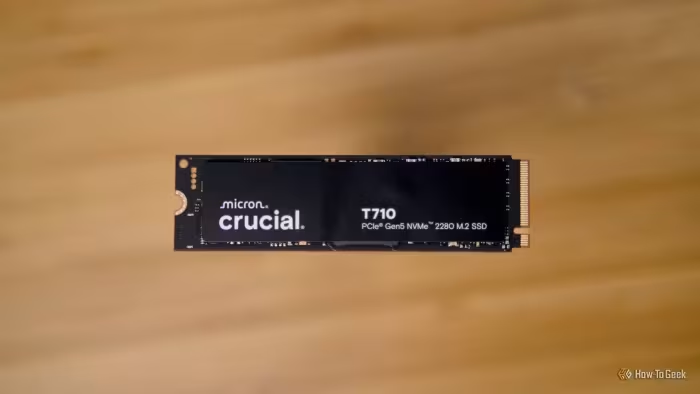
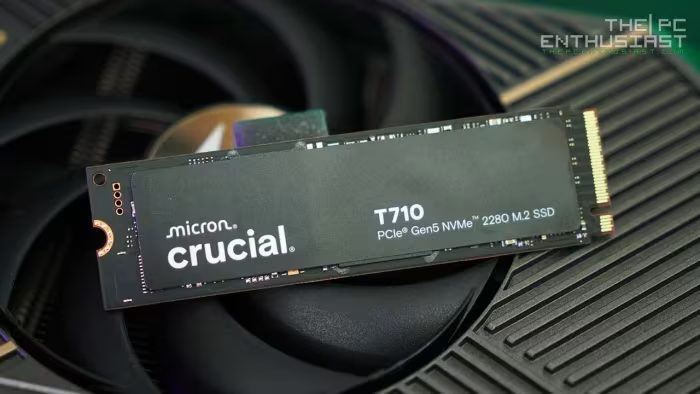
This M.2 2280 drive features a Silicon Motion SM2508 controller and high-speed Micron 3D TLC NAND. While it offers PCIe 5.0 performance, its plastic label limits thermal efficiency.
Pros
- Supports fast PCIe 5.0 x4 interface
- Includes dedicated DRAM cache
- Uses advanced 276-layer 3D TLC NAND
Cons
- Plastic sticker lacks integrated cooling
- Potentially higher operating temperatures
Crucial T710 2 TB Review - Record-Breaking Gen 5 | TechPowerUp - techpow...
Price: Approximately ₹15,000 to ₹46,000
The Crucial T710 is a flagship PCIe 5.0 SSD leveraging the efficient Silicon Motion SM2508 controller and Micron's advanced 276-layer 3D TLC NAND. It offers a solid balance of performance and thermal efficiency for high-end storage users.
Pros
- Uses efficient Silicon Motion SM2508 controller
- Features high-quality Micron 276-layer 3D TLC NAND
- Includes 2 GB LPDDR4 DRAM cache
- Available with optional heatsink
- Backed by a five-year warranty
Cons
- Premium pricing for 4 TB model
- Heatsink adds extra cost
crucials new t710 ssd is blazing fast and designed for creatives ProsCon...
The Crucial T710 PCIe Gen5 NVMe SSD comes in 1TB, 2TB, and 4TB drive sizes with read and write speeds up to 14.9GB/s. As one of the fastest NVMe drives on the market, the performance of the T710 is unparalleled.
Pros
- Ultra-fast read and write speeds
- Can choose between purchasing with and without a heat sink
- Up to 4TB storage options available
Cons
- The fast read and write speeds are limited in usage to creative tasks
- Relatively expensive compared to other drives on the market due to its high performance
Page 1 of 2