Bambu Lab H2C 3D Printer Review

Bambu Lab H2C
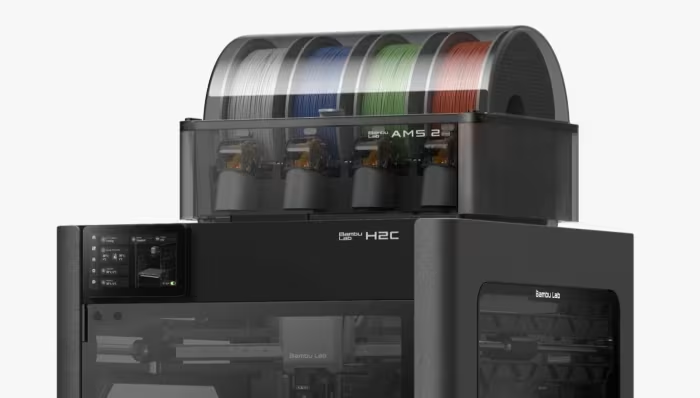
A high-performance, professional-grade 3D printer featuring an innovative multi-nozzle Vortek tool-changing system for reduced waste and multi-material efficiency.
How This Score Is Calculated
- Sources analysed: 6 reviews
- Explicit scores: 0 sources
- Sentiment-only: 6 sources (weighted 1.0×)
- Split: 5 Positive · 1 Mixed · 0 Negative
- Raw weighted average: 8.8
- Consensus bonus +0.3: 83% sources agreed
- Final score: 8.8/10
- Most reviewed featureVortek System (6/6)
- Most praisedWaste Reduction
- Most criticisedHigh Price
- Reviewer consensus levelHigh
- Value for moneyFair Value (6.0/10)
The Bambu Lab H2C is a groundbreaking desktop 3D printer that distinguishes itself through an innovative multi-nozzle Vortek tool-changing system. It excels in minimizing filament purge waste while supporting complex multi-material prints with up to 24-filament capacity. While its premium price and increased mechanical complexity may deter beginners, it remains an indispensable tool for power users and small-scale production environments.
🔧 Key Specifications
Specifications sourced from reviewer mentions. Verify with manufacturer for complete details.
- Nozzle Temp: 350°C
- Chamber Temp: 65°C
- Filament Capacity: Up to 24 (via AMS expansion)
- Tool System: Vortek multi-nozzle tool-changer
- Heating: 8-second induction nozzle heating
- Compatibility: Bambu Studio, MakerWorld integration
- Build Volume: Slightly smaller than H2D (due to nozzle rack)
💲 Price Range
Approx. ₹2,00,000 – ₹3,50,000
- EUR: €2,249
- GBP: £1,999
- AUD: 3699 AUD
Prices sourced from reviews. Check current retailer pricing.
📊 What Reviewers Say — Feature by Feature
7 features evaluated across 6 sources.
👍 Key Strengths
- Innovative Vortek tool-changing system
- Significantly reduced filament waste
- High 350°C nozzle/65°C chamber temp
- Scalable 24-filament capacity
- Excellent user-friendly software ecosystem
👎 Key Weaknesses
- High premium price point
- Increased mechanical complexity
- Larger footprint due to AMS dependency
- Noisy operation during use
- USB drive formatting issues
💰 Value for Money Analysis
While reviewers acknowledge the H2C is expensive, they generally view it as a professional-grade investment rather than a casual purchase. Its value is tied to productivity gains, specifically the reduction in wasted filament and increased speed, which justifies the cost for power users and small businesses.
6 of 6 sources commented on price or value.
⚡ Where Reviewers Disagreed
The following areas saw meaningful disagreement across sources.
- Ease of Use: 3 sources praised its ease of use out of the box, while 2 sources warned that the complexity of the Vortek system and AMS management could feel overwhelming for less experienced users.
🎯 Who This Product Is For
Reviewer recommendations for different target audiences and use cases.
🛠️ Best Use Cases
- Small-Scale ProductionHigh temperature threshold (350°C) and reduced purge waste make it ideal for consistent, professional output.Great
- Multi-Material PrototypingThe Vortek system allows for seamless switching between materials like TPU, reducing the need for constant manual intervention.Great
- Home Hobbyist ProjectsWhile capable, the noise levels and high cost may be prohibitive for standard home setups.OK
🔀 Alternatives Mentioned by Reviewers
Maximise this list. Include EVERY single competitor, rival, or alternative product mentioned in any of the source reviews. Do not omit any. More alternatives and longer lists are better.
- Bambu Lab H2D — The predecessor model. It is cheaper and has a larger build volume but lacks the advanced Vortek tool-changing system and produces significantly more purge waste. Choose this if budget is a primary concern.
- Bambu Lab H2S — Mentioned as having fewer moving parts than the H2C. It is a simpler, more established platform, though it lacks the H2C's advanced multi-nozzle efficiency.
- Prusa XL — A direct competitor in the multi-tool head space. Unlike the H2C's nozzle-swapping system, the Prusa uses full tool heads for each filament. Reviewers note this is a different architectural approach to multi-material printing.
- Snapmaker U1 — Another multi-tool head system alternative. Compared to the H2C, it represents a different design philosophy for managing multiple materials, which reviewers contrast with the H2C's unique hot-end swapping method.
Alternatives sourced exclusively from reviewer mentions.
🛒 Buyer's Guide
✅ Buy This If…
- You need professional-grade, high-volume 3D printing capabilities.
- You frequently print with multiple materials and want to minimize purge waste.
- You require high-temperature support (350°C) for specialized filaments.
❌ Skip This If…
- You are a casual hobbyist with a limited budget.
- You prefer a simple, low-maintenance printer with fewer moving parts.
- You are sensitive to machine noise in your workspace.
⚠️ Things to Check Before Buying
- Ensure you have the physical space required for the AMS units, which significantly increase the total footprint.
- Be prepared to manage the complexity of a multi-nozzle system compared to standard single-nozzle printers.
- Check current local pricing, as it varies significantly by region (India/Europe/Australia).
📈 Sentiment Trends Over Time
Reviews indicate a shift in perception since the H2D launch.
- Efficiency — The move to the Vortek system is seen as a major technical leap over the H2D/H2S series, specifically regarding waste reduction.
Long-term impressions emphasize that while the H2C is more complex, the trade-off in efficiency is viewed as a positive evolution in Bambu Lab's product line.
The Bambu Lab H2C is an outstanding, professional-grade machine that redefines multi-material efficiency through its innovative Vortek system. While its high price and complex mechanical setup make it less ideal for casual users, its performance and low-waste capabilities are unmatched. For power users and small-scale production, this is currently the benchmark to beat. If the cost is too high, the older H2D remains a capable, more affordable alternative.
Top Alternative: Bambu Lab H2D — A more budget-friendly option if you can sacrifice the advanced multi-nozzle tool-changing capabilities of the H2C.
Reviewer Perspectives & Source Breakdown
VoxelMatters Review: Bambu Lab's H2C is possibly the coolest desktop 3D ...
Price: approx. ₹2,02,000
The Bambu Lab H2C is arguably the most impressive 3D printer currently on the market, offering groundbreaking capabilities despite its high price. Its innovative multi-nozzle Vortek system and seamless software ecosystem make it a top-tier choice for power users.
Pros
- Innovative Vortek multi-nozzle tool-changing system
- Significantly reduces purge waste during multi-material prints
- Fast 8-second induction heating for nozzle swaps
- Extremely user-friendly setup and calibration process
- Excellent integration with MakerWorld and Bambu Studio
Cons
- High price point of €2,249
- Can feel overwhelming for less experienced users
- Requires careful management of multiple AMS units
Bambu Lab H2C 3D printer review - remarkable device that has created our...
Price: 3699 AUD (approx. 200,000 INR)
The Bambu Lab H2C is a high-performance, user-friendly 3D printer that offers remarkable print quality and multi-color capabilities. While it is an expensive investment, its reliability and advanced features make it an indispensable tool for both hobbyists and professionals.
Pros
- Easy to use right out of the box
- Stunning print quality
- Ability to include multiple colours in a print
- Having up to 24 filaments ready to go
Cons
- Expensive
- USB drive needs to be constantly formatted
- Can be a little noisy
Bambu Lab H2C 3D printer review | TechRadar - techradar.com...
Price: Approximately ₹2,00,000 to ₹3,50,000
The Bambu Lab H2C is an innovative multi-nozzle 3D printer that significantly reduces filament waste while offering support for up to 24 filaments. It stands as a powerful, professional-grade machine for small-scale production environments.
Pros
- Innovative design with significantly lower waste
- High 350°C nozzle and 65°C chamber temperature
- Scalable up to 24 filaments via AMS expansion
Cons
- Premium, expensive pricing
- More complex with more moving parts than predecessors
- Increased footprint and cost due to AMS dependency
The Maker’s Toolbox: Bambu Lab H2C 3D Printer Review - Hackster.io - hac...
Price: Approx. ₹2,00,000
The Bambu Lab H2C is a superior choice over the H2D due to the Vortek system, which significantly improves print speed and reduces filament waste. While it carries a higher price and slightly smaller build volume, the efficiency gains and nozzle versatility make it a compelling upgrade.
Pros
- Vortek system enables faster filament swaps
- Significantly reduces purge waste compared to H2D
- Ability to dedicate nozzles to specific materials like TPU
- Support for automated switching between different nozzle sizes
Cons
- More expensive than the H2D model
- Slightly smaller build volume due to nozzle rack
- Build plates are not interchangeable with H2D
- Vortek nozzle system is more complex than standard setups
bambu lab h2c 3d printer review remarkable device that has created our...
The Bambu Lab H2C has taken 3D printing to another level and will astonish you with the results. Whether you are printing for your own enjoyment, as a professional or creating objects that can be used around the home – the H2C can easily become an indispensable tool for many households.
Pros
- Easy to use right out of the box
- Stunning print quality
- Ability to include multiple colours in a print
- Having up to 24 filaments ready to go
Cons
- Expensive
- USB drive needs to be constantly formatted
- Can be a little noisy
ive spent the past month testing the bambu lab h2c 3d printer and its no...
The H2C isn't it exactly what we were expecting? It's a multi-nozzle changer rather than a tool changer; however, it is still impressive in that it delivers the ability to print with seven filaments out of the box and cuts down on waste. So, whilst it's still not perfect, it's a huge step in the right direction and again reinforces Bambu Lab's position in innovation. £1,999 at Bambu Lab Check Amazon
Pros
- Innovative and far lower waste
- 350 °C nozzle, 65 °C chamber.
- AMS expansion up to 24 filaments.
Cons
- Premium pricing.
- More moving parts than H2S/H2D.
- AMS dependency increases footprint and cost.