AMD Radeon RX 9070 XT Review
AMD Radeon RX 9070 XT
A powerful RDNA 4-based graphics card delivering high-performance 1440p and 4K gaming with a strong value proposition.
How This Score Is Calculated
- Sources analysed: 13 reviews
- Raw weighted average: 8.2
- Formula: Σ(score × weight) ÷ Σ(weight)
- Value sources: 11 of 13 mentioned price or value
- Final score: 8.2/10
- Most reviewed featureRay Tracing (11/13)
- Most praisedValue/Price
- Most criticisedPower Consumption
- Reviewer consensus levelHigh
- Value for moneyExcellent Value (8.5/10)
The AMD Radeon RX 9070 XT is widely regarded as a high-performance, future-proof GPU that excels in 1440p and 4K gaming rasterization. Its primary strength lies in its exceptional price-to-performance ratio, particularly when compared to NVIDIA’s higher-priced offerings. While it faces criticism for high power consumption and inconsistent ray tracing performance, it remains a top-tier choice for gamers prioritising raw frames over the premium software ecosystem of its rivals.
🔧 Key Specifications
- Architecture: RDNA 4
- VRAM: 16GB GDDR6
- Interface: 256-bit
- Power Draw: 304W
- Recommended PSU: 800W
- AI Features: FSR 4 (ML-based)
💲 Price Range
$599 MSRP / Approx. ₹50,500 – ₹67,000
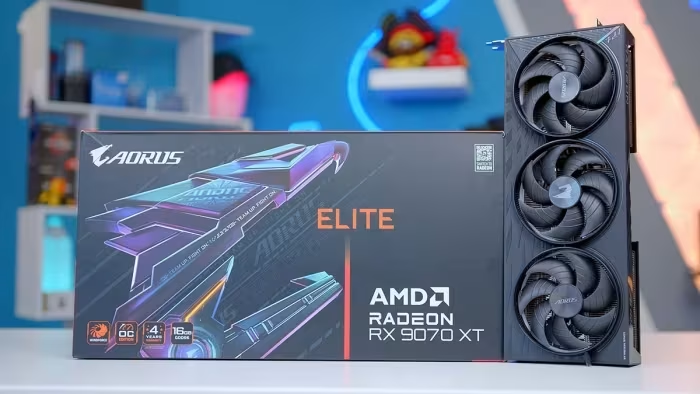
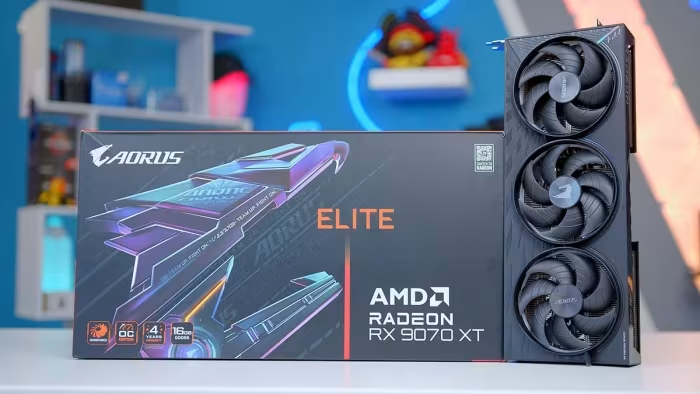
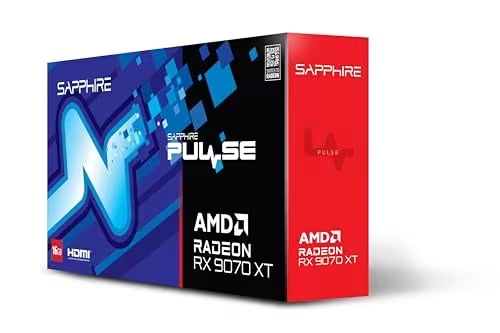
Prices vary by region and model (e.g., Sapphire Pulse, Pure, AORUS Elite).
📊 What Reviewers Say — Feature by Feature
6 features evaluated across 13 sources.
👍 Key Strengths
- Exceptional 4K and 1440p rasterization performance
- Highly competitive $599 price point
- Generous 16GB VRAM for future-proofing
- Significant generational ray tracing improvements
- Solid build quality on partner models
👎 Key Weaknesses
- High 304W power consumption under load
- Inconsistent ray tracing performance in titles
- Software ecosystem trails NVIDIA's maturity
- Retail availability and scalping concerns
- FSR 4 support not yet widespread
💰 Value for Money Analysis
Reviewers overwhelmingly view the $599 MSRP as a "steal" compared to the NVIDIA RTX 5070 Ti, providing superior performance-per-dollar in rasterization. While some premium partner models inflate the price, the base value proposition remains a primary selling point.
11 of 13 sources commented on price or value.
⚡ Where Reviewers Disagreed
The following areas saw meaningful disagreement across sources.
- Ray Tracing Viability: 6 sources praised the "significant improvements" in ray tracing, while 5 sources noted it remains "unplayable" or "inconsistent" without Frame Generation. This suggests the utility of the feature is highly game-dependent.
🎯 Who This Product Is For
Reviewer recommendations for different target audiences and use cases.
🛠️ Best Use Cases
- 1440p Gaming Excellent performance for high-refresh-rate 1440p gaming. Great
- 4K Gaming Highly capable for 4K, though ray-traced settings may require Frame Generation. Good
- Content Creation The 16GB VRAM buffer assists in memory-intensive creation tasks. Good
🔀 Alternatives Mentioned by Reviewers
- NVIDIA GeForce RTX 5070 Ti — The primary competitor. While it offers superior ray tracing and better power efficiency, it is significantly more expensive. Choose this if you prioritize the NVIDIA software ecosystem and ray tracing performance.
- NVIDIA GeForce RTX 5070 — A direct competitor that the RX 9070 XT often outperforms in raw rasterization. Choose this only if you specifically require DLSS and NVIDIA-exclusive software features.
- AMD Radeon RX 7900 XTX — An older high-end card that the 9070 XT now rivals in raster performance. Consider this only if you find it at a heavily discounted price.
- AMD Radeon RX 9060 XT — A lower-tier card. The 9070 XT is a significant step up (approx. 29% faster). Choose the 9060 XT only if your budget is strictly under the $500 mark.
🛒 Buyer's Guide
✅ Buy This If…
- You want the best performance-per-dollar for 4K gaming.
- You prioritize 16GB VRAM for future-proofing your build.
- You primarily play games that benefit from raw rasterization power.
❌ Skip This If…
- You prioritize Ray Tracing performance above all else.
- Your current power supply is under 800W and you aren't willing to upgrade.
- You require a mature software ecosystem like NVIDIA's for professional work.
⚠️ Things to Check Before Buying
- Check current retail pricing as scalping can significantly alter the value proposition.
- Verify your power supply unit capacity (800W recommended).
- Check if your preferred games support FSR 4 Frame Generation.
The AMD Radeon RX 9070 XT is a formidable midrange graphics card that punches well above its weight in rasterization performance. Its 16GB VRAM and competitive $599 pricing make it a clear winner for value-focused gamers, despite its high power draw and lagging ray tracing performance. We recommend this card for any enthusiast looking for a high-performance 4K experience without the premium tax of NVIDIA cards. If Ray Tracing is your absolute priority, consider the RTX 5070 Ti instead.
Reviewer Perspectives & Source Breakdown
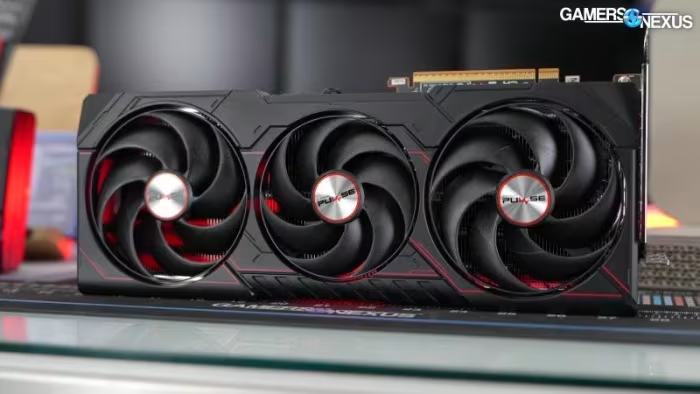
Sapphire Pulse AMD Radeon RX 9070 XT 16GB GDDR6 Review: RDNA 4 Delivers ...
Price: approx. 60,000 INR
The Sapphire Pulse RX 9070 XT is a high-performance, future-proof graphics card that offers excellent 1440p and 4K gaming capabilities. While it consumes significant power and faces stiff competition from Nvidia's ecosystem, its 16GB VRAM and improved ray tracing make it a top-tier choice for enthusiasts.
Pros
- Substantial 16GB VRAM for future-proof 1440p and 4K gaming
- Significant generational leap in ray tracing performance
- FSR 4 ML-based upscaling is highly competitive
- Solid build quality and reliable cooler design
Cons
- High 304W power draw requires an 800W PSU
- AMD driver ecosystem still less polished than Nvidia
- FSR 4 game support is not yet widespread
AMD Radeon RX 9070 XT Review - GeekaWhat - geekawhat.com...
Price: Approximately ₹50,500
The RX 9070 XT offers competitive performance at a compelling price point. It holds its own against higher-priced NVIDIA alternatives, making it a strong value proposition for gamers.
Pros
- Excellent 1440p and 4K gaming performance
- Competitive $599 MSRP
- Generous 16GB GDDR6 VRAM
- Improved RDNA4 ray tracing performance
Cons
- Higher power consumption than predecessors
- Still relies on GDDR6 instead of newer GDDR7
- Basic aesthetics on reference models
- FSR technology remains behind NVIDIA's DLSS
AMD Radeon RX 9070 XT and RX 9070 review: Excellent value, if supply is ...
Price: Approx. ₹58,000 - ₹63,000
The RX 9070 XT offers impressive mainstream performance and significant generational improvements in AI and ray tracing. However, potential retail availability issues and stiff competition from Nvidia's software ecosystem remain notable concerns.
Pros
- Excellent mainstream value and performance
- Significant generational improvements over RDNA 3
- Greatly improved AI and ray tracing capabilities
- Solid 16GB of VRAM capacity
Cons
- Uncertainty regarding retail availability and pricing
- Trails Nvidia in ray tracing and AI performance
- Nvidia maintains an advantage in software support
AMD Radeon RX 9070 XT GPU Review & Benchmarks vs. 5070 Ti, 5070, 7900 XT...
Price: $600 (Approx. ₹50,500)
The RX 9070 XT offers competitive rasterized performance that rivals more expensive NVIDIA cards, though its ray tracing capabilities remain inconsistent. It serves as a strong generational improvement for AMD, often trading blows with the RTX 5070 Ti.
Pros
- Strong competitive performance in rasterized gaming workloads
- Significant ray tracing improvements over previous generation
- 16GB GDDR6 memory is advantageous for heavy tasks
- Provides high value compared to pricier NVIDIA alternatives
Cons
- Ray tracing performance varies significantly by game title
- Performance can fall behind RTX 5070 in specific titles
- Availability may be impacted by potential scalping
AMD Radeon RX 9070 GRE fills the gap between RX 9060 XT and RX 9070 in f...
The card performs well for QHD gaming, acting as a solid midpoint between lower and higher-end offerings. However, its 12GB VRAM buffer limits its performance in demanding, memory-intensive scenarios.
Pros
- Good performance for 1440p gaming
- Provides good value for its segment
- Solid performance relative to the RX 9060 XT
Cons
- 12GB VRAM buffer limits higher-resolution performance
- Struggles more in ray-traced scenarios
- Falls behind predecessors with 16GB VRAM in 4K
Sapphire Radeon RX 9070 XT Pulse Review - FSR 4 & AMD Software | TechPow...
AMD's FSR 4 introduces a significant leap in performance by utilizing dedicated AI hardware within RDNA 4 GPUs for machine learning-based upscaling. This update makes FSR technology architecturally more similar to NVIDIA's DLSS while improving ray tracing de-noising.
Pros
- ML-based upscaling improves detail reconstruction
- Dedicated AI acceleration on RDNA 4
- Enhanced ray tracing and path tracing de-noising
- Updated AMD Software with AI chatbot features
Cons
- FSR 4 features are exclusive to RX 9000 series
- Requires dedicated AI hardware to function
Sapphire PURE AMD Radeon RX 9070 XT Review: Cooling, Specs & Gaming Benc...
Price: Approx. ₹58,000 - ₹67,000
The Sapphire RX 9070 XT Pure Edition offers exceptional rasterization performance and a sleek aesthetic at a competitive price. While it lacks the efficiency and ray-tracing superiority of its NVIDIA rival, it remains a high-value choice for gamers focused on raw performance.
Pros
- Sophisticated and clean all-white matte design
- Competitive performance in rasterization gaming
- Effective triple-fan cooling system
- Robust build quality with a metal backplate
- More affordable than the RTX 5070 Ti
Cons
- High memory temperatures under load
- Lags significantly behind NVIDIA in path-tracing
- Lower energy efficiency compared to NVIDIA
- Less mature software ecosystem than NVIDIA
Sapphire Pulse AMD Radeon RX 9070 XT - Review 2025 - PCMag Australia - a...
Price: Approximately ₹50,500
The Radeon RX 9070 XT is a powerful midrange GPU that delivers significantly improved ray tracing performance and strong value. It serves as an excellent choice for 1440p and light 4K gaming at its $599 price point.
Pros
- Highly competitive price
- Greatly improved ray-tracing performance
- Strong performance in many gaming titles
- Stays cool under load
- Capable AI performance in LLM benchmarks
Cons
- Non-ray-tracing performance lags behind last-gen Radeon GPUs
Sapphire Pulse AMD Radeon RX 9070 XT Review | PCMag - pcmag.com...
Price: Approximately ₹50,500 (based on $599 USD)
The Radeon RX 9070 XT is a powerful midrange GPU that delivers significantly improved ray tracing performance and competitive gaming capabilities. Its strong value proposition at the $599 price point makes it an excellent choice for 1440p and light 4K gaming.
Pros
- Highly competitive price point
- Greatly improved ray-tracing performance
- Strong performance in many titles
- Stays cool under load
- Solid AI performance in LLM benchmarks
Cons
- Non-ray-tracing performance lags behind last-gen Radeon GPUs
Page 1 of 2