AMD Radeon RX 9060 XT Review

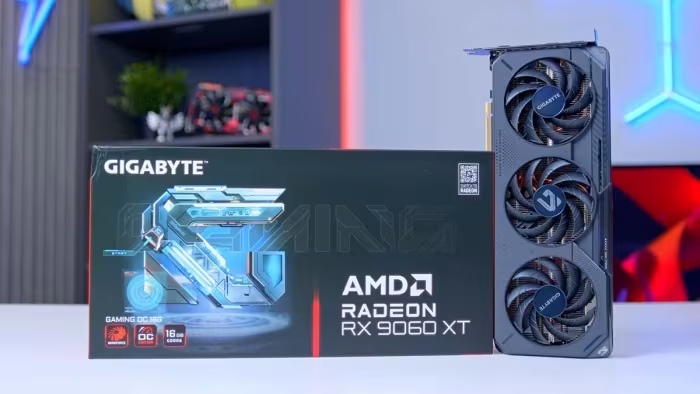
AMD Radeon RX 9060 XT
A mainstream RDNA 4 graphics card featuring 16GB of VRAM, positioned as a future-proof alternative to 8GB Nvidia competitors.
How This Score Is Calculated
- Sources analysed: 9 reviews
- Explicit scores: 0 sources (all based on sentiment)
- Sentiment-only: 9 sources (weighted 1.0×)
- Split: 6 Positive · 2 Mixed · 1 Negative
- Raw weighted average: 7.4
- Formula: Σ(score × weight) ÷ Σ(weight)
- Consensus bonus +0.3: 67% sources agreed
- Final score: 7.4/10 (clamped, rounded to 1 decimal)
- Most reviewed feature16GB VRAM (9/9)
- Most praisedVRAM Capacity
- Most criticisedFSR vs DLSS Ecosystem
- Reviewer consensus levelHigh
- Value for moneyGood Value (7.5/10)
The AMD Radeon RX 9060 XT is widely regarded as a high-value mainstream GPU that distinguishes itself primarily through its generous 16GB VRAM buffer. While it struggles to beat Nvidia’s top-tier performance in machine-learning features like frame generation, it offers a more future-proof architecture for 1440p gaming. It is best suited for budget-conscious gamers who prioritize memory capacity over cutting-edge AI software suites.
🔧 Key Specifications
- VRAM: 8GB or 16GB options
- Architecture: RDNA 4
- TGP: 160W
- Upscaling: FSR 4
- Display Output: Single DisplayPort mentioned
- Ray Tracing: Improved over previous generation
💲 Price Range
Approximately ₹25,200 – ₹38,500
Prices vary by region and model (8GB vs 16GB variants).
📊 What Reviewers Say — Feature by Feature
👍 Key Strengths
- Generous 16GB VRAM buffer
- Efficient 160W power consumption
- Solid 1440p gaming performance
- Improved ray tracing capabilities
👎 Key Weaknesses
- FSR 4 lags behind DLSS
- 8GB variant is poorly positioned
- Inconsistent 4K gaming performance
- Limited software ecosystem adoption
💰 Value for Money Analysis
The 16GB model is widely considered a strong value-tier contender, especially when compared to the limitations of 8GB Nvidia alternatives. However, reviewers warn that the 8GB variant of this card is significantly overpriced for its performance tier.
⚡ Where Reviewers Disagreed
- 4K Performance: Some reviewers noted solid performance, while others highlighted significant inconsistency and struggle at 4K resolutions.
🎯 Who This Product Is For
🛠️ Best Use Cases
- 1440p Gaming The 16GB VRAM provides a clear advantage over 8GB cards in memory-intensive titles. Great
- 4K Gaming Performance is highly variable and often struggles compared to higher-tier cards. Poor
🔀 Alternatives Mentioned by Reviewers
- Nvidia GeForce RTX 5060 Ti — Often compared as a direct rival; while it offers superior machine-learning and DLSS quality, it is frequently criticized for its limited 8GB memory buffer.
- Nvidia GeForce RTX 5060 — A standard budget competitor that the RX 9060 XT outperforms by roughly 10% in rasterized tasks.
- AMD Radeon RX 9070 — A higher-tier option that outperforms the 9060 XT by 14% at 1440p, recommended for those needing more raw power.
- AMD Radeon RX 7600 XT — The predecessor to the 9060 XT; reviewers note that the 9060 XT lacks a massive generational leap in shader count compared to this model.
🛒 Buyer's Guide
✅ Buy This If…
- You want a future-proof card for 1440p gaming.
- You prioritize VRAM capacity over advanced AI software features.
❌ Skip This If…
- You are considering the 8GB version of this card.
- You rely heavily on DLSS for your gaming workflow.
The AMD Radeon RX 9060 XT 16GB is a solid, efficient choice for gamers who value long-term memory capacity for 1440p titles. While it lacks the software polish of Nvidia’s ecosystem, its raw value proposition remains high. We recommend opting for the 16GB model and avoiding the 8GB variant entirely.
Reviewer Perspectives & Source Breakdown
AMD Radeon RX 9060 XT 16GB review: plenty of performance with 16GB | Tom...
Price: Approx. ₹32,500 - ₹38,500
The AMD Radeon RX 9060 XT 16GB is a standout mainstream GPU that delivers excellent value and performance. Its generous 16GB of VRAM makes it a superior and more future-proof choice compared to Nvidia’s competing 8GB cards.
Pros
- Great value and performance
- 16GB VRAM avoids memory bottleneck issues
- RDNA 4 architecture improves RT and AI features
- Solid availability at launch
Cons
- AMD lags behind in software features like FSR
- 16GB models currently sell above MSRP
- Nvidia's Blackwell GPUs hold a raw memory bandwidth advantage
AMD Radeon RX 9060 XT 16GB Review - GeekaWhat - geekawhat.com...
Price: Approximately ₹29,300
The Radeon RX 9060 XT 16GB is a strong budget-tier contender that justifies its price through superior VRAM capacity compared to 8GB alternatives. While it is not a visual standout, its efficient performance and FSR4 support make it a compelling choice for modern gaming.
Pros
- Generous 16GB VRAM capacity
- Power-efficient 160W TGP
- Solid 1080p gaming performance
- Effective AI-powered FSR4 technology
Cons
- Underwhelming aesthetic design
- Limited RGB implementation
- Ray tracing performance remains unproven
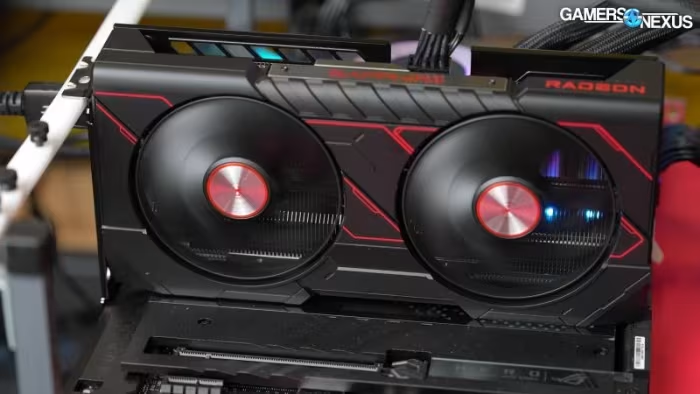
AMD Needs to Just Shut Up: AMD Radeon RX 9060 XT 16GB GPU Review | Gamer...
Price: Rs 29,400 for 16GB, Rs 25,200 for 8GB
The RX 9060 XT offers modest performance gains over its competitors, but the 8GB model is poorly positioned for modern gaming. AMD's marketing strategy remains aggressive and contradictory regarding memory needs, undermining the value of the 16GB variant.
Pros
- Improved ray tracing performance over previous generations
- Very quiet cooling solution
- Hitting advertised boost frequencies
- Acceptable GPU thermal temperatures
Cons
- 8GB VRAM is inadequate for a 300 dollar GPU
- Misleading marketing regarding VRAM necessity
- Significant inconsistency in 4K gaming performance
- Large delta between core and hot spot temperatures
AMD Radeon RX 9070 GRE fills the gap between RX 9060 XT and RX 9070 in f...
The card performs well for QHD gaming, acting as a solid midpoint between lower and higher-end offerings. However, its 12GB VRAM buffer limits its performance in demanding, memory-intensive scenarios.
Pros
- Good performance for 1440p gaming
- Provides good value for its segment
- Solid performance relative to the RX 9060 XT
Cons
- 12GB VRAM buffer limits higher-resolution performance
- Struggles more in ray-traced scenarios
- Falls behind predecessors with 16GB VRAM in 4K
Call of Duty: Black Ops 7 Performance Review: AMD Radeon RX 9060 XT vs N...
The AMD Radeon RX 9060 XT outperforms the Nvidia RTX 5060 Ti in raw frame rates and stability, particularly with ray tracing and frame generation. However, Nvidia maintains an edge in frame generation quality due to its superior machine-learning implementation.
Pros
- Superior raw average frame rates
- Better performance stability with ray tracing
- Minimal stuttering with frame generation enabled
- Effective FSR Ray Regeneration technology
Cons
- Inferior machine-learning based frame generation
- Minor stuttering observed in specific FSR presets
amd radeon rx 9060 xt review ProsCons...
The AMD Radeon 9060 XT meets, and in some cases even exceeds, expectations. If it is available in the ₹35,000 range, the 16GB model will set a new benchmark for GPUs in its category.
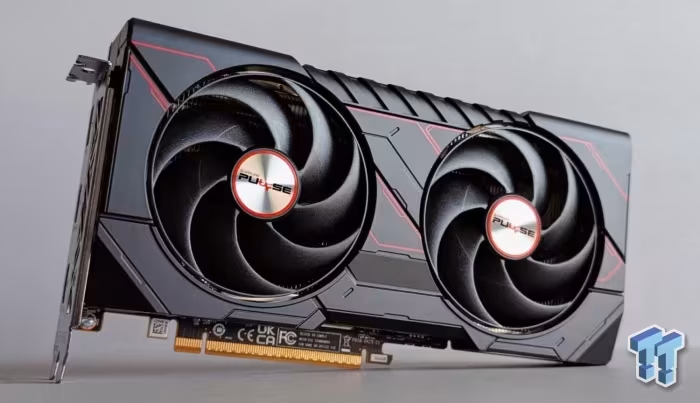
sapphire pulse amd radeon rx 9060 xt 16gb graphics card review ProsCons...
In terms of raw performance, the Radeon RX 9060 XT aligns proportionally with its higher-tier sibling, the RX 9070 XT. However, while the 9070 XT exceeded expectations—punching above its weight thanks to a shader count that surpassed even the RX 7800 XT—the 9060 XT makes no such leap. With the same number of shader cores as its predecessor, the RX 7600 XT, it doesn’t push the boundaries in the same way. As a result, it lacks the standout appeal that might have been expected from a next-generation upgrade.
Pros
- FSR4 Supported
- 16 GB VRAM
- Decent AI performance
Cons
- Indian Pricing unknown
- FSR still trails DLSS
sapphire radeon rx 9060 xt 16gb pulse oc review amds best mainstream gpu...
Sure, overall performance sits between the GeForce RTX 5060 and RTX 5060 Ti, but the SAPPHIRE Radeon RX 9060 XT 16GB PULSE OC is proof that RDNA 4 is the start of a new era for AMD gaming GPUs. Compared to the Radeon RX 7600, it's night and day, with impressive ray-tracing and FSR 4.
Pros
- Finally, a mainstream Radeon GPU that can handle ray-tracing
- 16GB of VRAM makes it great for 1080p and 1440p gaming
- FSR 4 image quality is excellent, a real DLSS competitor
- A massive improvement over the Radeon RX 7600
- Sapphire's quiet, efficient, and robust PULSE design
Cons
- FSR 4 adoption is growing, but slowly
- Not much faster than the GeForce RTX 5060 and slower than the RTX 5060 Ti
- Only a single DisplayPort
asrock radeon rx 9060 xt 16gb steel legend oc review amd brings the figh...
With RDNA 4, the ASRock Radeon RX 9060 XT 16GB Steel Legend OC offers a viable alternative to mainstream GeForce RTX thanks to improved ray-tracing performance and FSR 4. Although it's not dramatically faster than the RTX 5060, getting 16GB of VRAM does make it a better 1440p choice.
Pros
- 16GB of VRAM makes it great for 1440p gaming
- Excellent ray-tracing performance for a mainstream Radeon GPU
- FSR 4 is a game-changer for AMD's upscaling tech at 180p and 1440p
- A viable alternative to the GeForce RTX 5060 Series
- ASRock's Steel Legend model is fast and runs remarkably cool
Cons
- FSR 4 adoption still has a ways to go to catch up to DLSS
- There's a huge performance gap between the 9060 XT and 9070