Agentic AI Review

Agentic AI
A transformative paradigm where autonomous AI systems act as collaborative coworkers rather than passive digital tools.
How This Score Is Calculated
- Sources analysed: 6 reviews
- Sentiment-only: 6 sources (weighted 1.0×)
- Split: 5 Positive · 1 Mixed · 0 Negative
- Raw weighted average: 7.8
- Formula: Σ(score × weight) ÷ Σ(weight)
- Review period: 2024
- Final score: 7.8/10 (clamped, rounded to 1 decimal)
Algorithmically calculated from source data. No manual adjustments.
- Most reviewed featureOrganizational Integration (4/6)
- Most praisedAutonomous decision-making
- Most criticisedHigh implementation overhead
- Reviewer consensus levelHigh
Agentic AI represents a significant shift from passive automation to autonomous, goal-oriented systems capable of complex decision-making. While it offers transformative potential for healthcare efficiency and enterprise business processes, successful adoption requires deep organizational restructuring rather than simple software layering. It is best suited for organizations prepared to invest in robust infrastructure and for professionals seeking advanced technical mastery.
🔧 Key Specifications
Specifications sourced from reviewer mentions. Verify with manufacturer for complete details.
- Core Tech: Autonomous decision-making agents
- Primary Infrastructure: PostgreSQL-based (e.g., EDB Postgres AI)
- Deployment: Hybrid, multi-cloud
- Human Oversight: Mandatory human-in-the-loop safeguards
- Data Requirements: Unified transactional and analytical workloads
📊 What Reviewers Say — Feature by Feature
5 features evaluated across 6 sources.
👍 Key Strengths
- Autonomous complex decision-making
- Significant reduction in low-value work
- Unified data and AI workloads
- Enhanced clinician and employee productivity
👎 Key Weaknesses
- High enterprise-wide infrastructure investment
- Ambiguity regarding accountability and ownership
- Requires rigorous organizational protocols
- Steep learning curve for developers
🎯 Who This Product Is For
Reviewer recommendations for different target audiences and use cases.
🛠️ Best Use Cases
- Healthcare AdministrationAutomates insurance claims and patient triage to reduce clinician burnout.Great
- Enterprise Data ManagementUnifying transactional and AI workloads within a sovereign, compliant infrastructure.Great
- Professional Skill DevelopmentBuilding a professional portfolio through hands-on agentic workflow projects.Good
🔀 Alternatives Mentioned by Reviewers
Maximise this list. Include EVERY single competitor, rival, or alternative product mentioned in any of the source reviews.
- Coursera / edX / DeepLearning.AI — Compared to the Udacity Nanodegree, these platforms are generally less project-driven. Choose Udacity for hands-on, portfolio-ready projects, whereas others may offer more theoretical or community-focused learning.
Alternatives sourced exclusively from reviewer mentions.
🛒 Buyer's Guide
✅ Buy This If…
- You are an enterprise leader ready for fundamental organizational restructuring.
- You are an intermediate developer looking to build complex agents from scratch.
- You require unified transactional and AI data sovereignty.
❌ Skip This If…
- You are a total beginner without Python programming skills.
- You are seeking a simple "plug-and-play" solution without infrastructure changes.
- You lack the organizational protocols to manage autonomous AI systems.
⚠️ Things to Check Before Buying
- Verify that your current data infrastructure is compatible with modern agentic AI requirements.
- Ensure you have a human-in-the-loop oversight committee established before deployment.
Agentic AI is a powerful, high-potential shift for organizations willing to embrace significant structural change. While its ability to automate complex workflows and unify data workloads is unmatched, it demands high investment and rigorous governance. For developers, the technology offers a path to advanced career skills, provided they have the necessary baseline knowledge. Approach this as a foundational strategy shift rather than a simple software purchase.
Reviewer Perspectives & Source Breakdown
SeekOut Review on Quasa: Agentic AI Recruiting Platform — Quasa - quasa....
SeekOut is a robust AI-powered recruiting platform offering both self-serve tools and managed services for technical and expert talent acquisition. It is highly recommended for teams seeking deep candidate insights and workflow automation.
Pros
- Massive talent index with over 1 billion profiles
- Dual deployment model for flexible recruiting
- Explainable AI for context-aware talent matching
- Seamless integration with major AI assistants
- Automated internal candidate rediscovery
Cons
- Costs scale based on team size and usage
- Requires well-defined rubrics for optimal AI results
- Effectiveness dependent on personalized outreach quality
Udacity Agentic AI Nanodegree Review (My Learning Expereince) - devopscu...
The Udacity Agentic AI Nanodegree is a highly practical, project-focused program ideal for intermediate Python developers. While it is expensive and lacks strong community features, its emphasis on building complex AI agents from scratch makes it a valuable investment for career advancement.
Pros
- Practical, hands-on project-based learning
- Deep conceptual understanding of agentic workflows
- Resume-ready projects for a professional portfolio
- Focuses on raw coding over simple framework abstraction
Cons
- High price point compared to some competitors
- Lack of active community support like Slack or Discord
- Not suitable for total beginners without Python knowledge
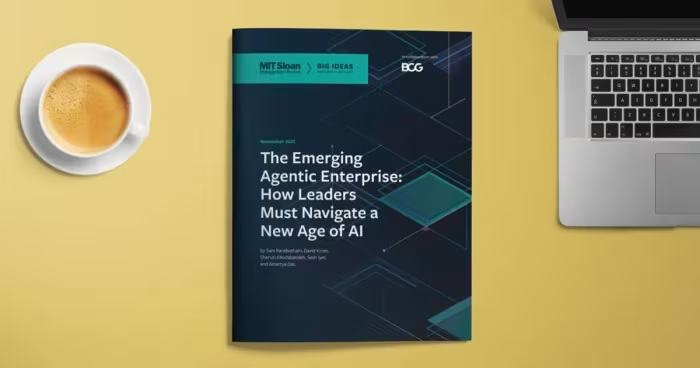
The Emerging Agentic Enterprise: How Leaders Must Navigate a New Age of ...
This report examines how organizations are integrating agentic AI as autonomous coworkers rather than mere tools. It highlights the resulting management tensions and the strategic necessity of bridging technology and human-centric operations.
Pros
- Provides deep insights into corporate AI adoption trends
- Identifies critical tensions in organizational strategy
- Offers professional guidance on managing agentic AI systems
Cons
- Focuses on management theory rather than specific software tools
- Requires corporate-level implementation to see benefits
Sovereignty Is the New Operating System for Agentic AI, New MIT Technolo...
EDB Postgres AI is an enterprise-grade platform designed to unify transactional, analytical, and AI workloads while ensuring data sovereignty. It provides secure, compliant, and scalable infrastructure built on the PostgreSQL foundation.
Pros
- Unifies transactional, analytical, and AI workloads
- Ensures secure and compliant data sovereignty
- Built on widely-used, open-source PostgreSQL infrastructure
- Offers up to 99.999% system availability
Cons
Sovereignty Is the New Operating System for Agentic AI, New MIT Technolo...
EDB Postgres® AI is an enterprise-grade platform designed to help organizations operationalize AI and data workloads while maintaining full sovereign control. The report highlights it as a foundational tool for achieving significantly higher ROI through secure, hybrid, and compliant AI infrastructure.
Pros
- Ensures data and infrastructure sovereignty
- Supports hybrid, multi-cloud deployment environments
- Unified transactional, analytical, and AI workloads
- Built on secure, enterprise-grade PostgreSQL
Cons
Rehumanizing global health care with agentic AI | MIT Technology Review ...
Agentic AI is being deployed in healthcare to automate administrative tasks and improve patient triage, aiming to reduce clinician burnout. It distinguishes itself from earlier digital tools by handling complex, autonomous decision-making with integrated human safeguards.
Pros
- Automates complex back-office processes like insurance claims
- Reduces cognitive load for medical clinicians
- Provides 24/7 patient scheduling and triage support
- Includes built-in human oversight and auditability
Cons
- Requires significant investment in unified data infrastructure
- Potential risk if human-in-the-loop safeguards fail
- Implementation requires rigorous organizational protocols and committees
Rethinking organizational design in the age of agentic AI | MIT Technolo...
The article discusses the concept of Agentic Business Transformation (ABT), arguing that organizations must fundamentally redesign their operations and infrastructure rather than simply layering AI agents onto existing processes. It highlights that successful integration requires adapting technology stacks, workforce structures, and success metrics to focus on outcomes.
Pros
- Accelerates business processes by 30% to 50%
- Reduces low-value work time by 25% to 40%
- Enables faster transition from business to production
- Shifts focus toward high-value outcome-based metrics
Cons
- Requires significant enterprise-wide organizational restructuring
- Current infrastructure is often incompatible with agentic needs
- Potential for complex management challenges in hybrid teams
- Creates ambiguity around accountability and ownership